Atal Setu at Dawn | Pune to Mumbai Tata Punch EV | 4K GoPro Road Trip Vlog
August 28, 2026 — ny_wk
As an Amazon Associate I earn from qualifying purchases.
As an Amazon Associate I earn from qualifying purchases.
🛒 Recommended gear on AmazonDisclosure: some links above are affiliate links — if you buy through them I may earn a small commission at no extra cost to you. Thanks for supporting the channel!
As an Amazon Associate I earn from qualifying purchases.
As an Amazon Associate I earn from qualifying purchases.
As an Amazon Associate I earn from qualifying purchases.
Driving across Atal Setu — India's longest sea bridge — at sunrise, after a 3 AM departure from Pune in a Tata Punch EV, is one of those experiences that lands differently from anything you planned on paper. The Mumbai Trans Harbour Link, which opened on January 12, 2024, stretches 21.8 kilometres across Thane Creek, connecting Sewri in Mumbai to Chirle in Navi Mumbai. Cross it in daylight on a weekend and it's a landmark. Cross it at 6:29 in the morning during monsoon season, with the sky going orange on both sides of the car and the city somewhere ahead in the haze, and it becomes something you won't easily explain to someone who wasn't there.
This is the full account of that drive — the planning behind it, what the road actually felt like at 3 AM, the engineering behind the bridge and the expressway, what it costs to run an EV on a 300-kilometre round trip, and how to do the same yourself if you want the bridge at its most cinematic.
Why Leave Pune at 3 AM for an Atal Setu Sunrise?
The math is simple once you work backward. Atal Setu faces roughly east-southeast across Thane Creek. Sunrise in Mumbai during August sits between 6:10 and 6:30 AM. The drive from central Pune to the Sewri approach of the bridge — via the Mumbai-Pune Expressway (NH48) — takes approximately two hours forty-five minutes in zero traffic. Add a short buffer for the Navi Mumbai approach roads and you need wheels rolling by 3:30 to 3:45 AM at the latest.
The 3 AM alarm is not a content decision. It is the only way to arrive at the right moment.
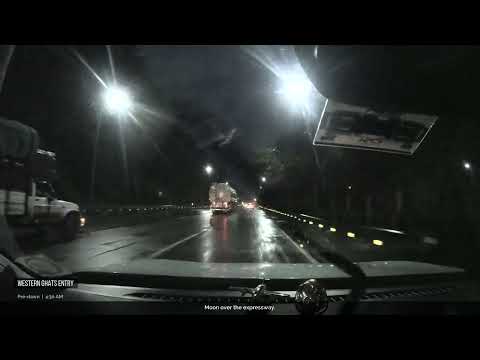
The secondary reason is the expressway itself. The Mumbai-Pune Expressway — India's first six-lane divided highway, 94 kilometres of engineered road built across the Sahyadri mountain range, opened in 2002 — is a genuinely different experience at that hour. The same road that crawls through truck convoys and bus traffic on a weekday afternoon becomes something closer to a private circuit. In the monsoon, with the road wet and the lane markers catching the headlights and nothing visible beyond the beam, there is a specific quality of attention it demands. You are not sightseeing. You are driving.
The rain arrived near Khopoli, about 50 kilometres from Pune. Proper, heavy monsoon rain — the kind that compresses the world to the width of your windshield. The western side of the Ghats receives the full force of the Arabian Sea moisture, and in August that force is significant. Visibility dropped, the road narrowed to what the headlights could hold, and the pass through the mountains became something to respect rather than enjoy. Then, crossing the crest and beginning the descent toward Navi Mumbai, the rain eased, the clouds opened, and the moon was still in the sky. That deep blue before sunrise — the one that only appears if you are already moving — sat above the expressway all the way into the city.
Crossing the Mumbai Trans Harbour Link at Dawn: Engineering and Experience
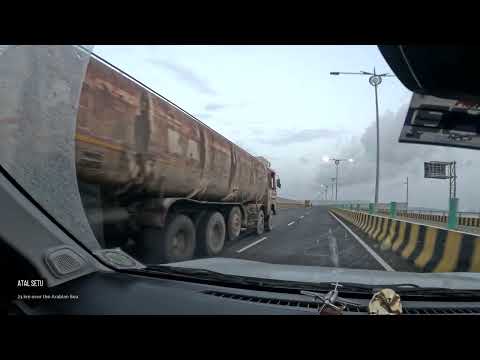
The approach to Atal Setu from Navi Mumbai is not dramatic until it suddenly is. The road bends, and then the bridge appears straight ahead across the water — 21.8 kilometres of elevated six-lane highway running due west across Thane Creek toward Mumbai. At dawn, with the sky changing colour and the water catching the light on both sides, the scale of it takes a moment to process.
The Mumbai Trans Harbour Link — officially named after former Prime Minister Atal Bihari Vajpayee — was nearly a decade in the making from groundbreaking to inauguration. The project navigated the considerable challenge of building across an active tidal estuary, with the added constraint of protecting the flamingo habitat in the creek below. The bridge uses precast segmental box girder construction across most of its span, with the total structure resting on approximately 17,000 piles. The main carriageway is elevated well above the water surface, which is why the crossing feels genuinely oceanic rather than merely coastal.
Crossing time at a normal speed: approximately 12 minutes. That sounds brief. It is not brief in the way it feels. For those 12 minutes you are suspended between land and water with nothing around you except the bridge structure and the open sky. On one side, the city you are approaching. On the other, the city you left. Neither feels fully real yet.
The bridge carries a toll in both directions. As of 2024–2025, the passenger car rate is ₹250 per direction (subject to revision; confirm current rates at the toll plaza). Fastag is accepted. The road surface on the main span is smooth and well-maintained; the approach ramps on the Navi Mumbai side showed some monsoon-roughness in the 2026 crossing.
What nobody warns you about: the crossing feels completely different at 10:45 AM on the return leg. Same 21.8 kilometres, same sea on both sides. But the monsoon clouds had rebuilt, the light was flat and high and silver, and the mood was nothing like the dawn version. It is, in the most literal sense, a different drive. If you can manage both directions in the same trip, do it.
South Mumbai at 7 AM: Marine Drive, Nariman Point, and the City's Quiet Window
Marine Drive — the 3.6-kilometre seafront promenade completed in 1940 that runs from Nariman Point along the Arabian Sea shore — does not sleep exactly, but it comes closest to stillness in that hour between 6:30 and 8:00 AM. The sweeping arc of the road, lit at night by its famous streetlights and chaotic by afternoon with pedestrians and parked cars, holds a particular quality at dawn in the monsoon: the sea running gray-green against the rocks below, joggers moving in small groups, the coffee stalls just beginning to set up, the apartment towers above still mostly dark.
Walking the promenade at that hour — down to the water's edge at the breakwater, back along the curve toward Nariman Point — takes about 45 minutes if you're moving at a pace that lets you actually look. The air is not clean by any absolute standard, but it is cool, the salt is real, and the city has not yet added the day's full load of vehicles. This is the version of Mumbai that residents know and visitors almost never see.
Nariman Point, Mumbai's central financial district, was itself built on land reclaimed from the Arabian Sea in the 1970s — one of the city's most significant reclamation projects after the Marine Drive foreshore itself. Standing at the tip of the point at 7 AM, looking south toward the open water with the city behind you, the reclamation history becomes briefly legible. This land did not exist a hundred years ago. The city grew into the sea, and the sea accepted it, and now it is one of the most expensive addresses in the country.
By 9 AM the lanes behind Nariman Point had started filling. The silence that a city of Mumbai's scale can produce only in the pre-working window had lifted, replaced by the ordinary daily friction. The appointment finished by 10:45. Time to find a charger.
Tata Punch EV Real-World Range and Charging on a 300 km Round Trip
The Tata Punch EV — in its Long Range configuration carrying a 35 kWh usable battery — arrived at Nariman Point with 21% remaining after roughly 160 kilometres from Pune (including the expressway and city approach). That is a realistic number for monsoon conditions: wipers running intermittently, AC on, overnight ambient temperature around 26°C, expressway speeds between 90 and 110 km/h. The EV is not being driven gently.
The Tata Power 60 kW DC fast charger at the Oberoi Hotel parking level — a few minutes from Nariman Point — brings the Punch EV from 21% to 89% in under an hour. The actual session on this trip was approximately 45 minutes, charging cost approximately ₹300. That number is the complete fuel cost for a 300-kilometre round trip including the Atal Setu toll approach.
For context: the same trip in a mid-size petrol car would consume roughly 18–22 litres at current Mumbai-Pune prices, putting the fuel bill somewhere around ₹2,000–2,500. The EV running cost is approximately one-eighth of that.
A few practical points for EV drivers planning this route:
- The Oberoi Hotel charger is public-access but requires a Tata Power EZ Charge account. Registration is free and the app handles payment.
- There are additional Tata Power DC fast chargers at several locations along the expressway, including at the Lonavala and Khalapur rest areas — useful as backup if you want to top up before entering the city rather than inside it.
- The Punch EV's onboard charger caps AC acceptance at 7.2 kW, so overnight AC charging from a hotel or home point is slow but fully covers the car by morning. Plan accordingly if staying overnight.
- At monsoon temperatures, battery thermal management is easier than summer peak — you are unlikely to see the thermal throttling that affects fast-charge speeds above 45°C ambient.
The 89% state of charge at departure from the Oberoi was enough to reach Pune with a comfortable margin. The car crossed the Ghats — the steepest sustained climb on the route, from Khopoli to the plateau — using regenerative braking aggressively on the descent, which recovered several percentage points. The Punch EV's regen tuning is notably well-matched to the Ghats gradient; the B mode paddle makes the descent feel almost effortless.
The Western Ghats Return: Mumbai-Pune Expressway and the Missing Link Bridge
The Mumbai-Pune Expressway going eastbound through the Western Ghats in peak monsoon is a different argument entirely from the 3 AM version. The Sahyadri range — the backbone of the Konkan coast, a UNESCO World Heritage Site, and one of the most ecologically significant mountain systems in Asia — turns a specific shade of green during the monsoon that you will not see at any other time of year. The 65-million-year-old Deccan basalt that forms the core of these hills is covered in vegetation so dense and vivid that it reads as slightly implausible, like something lit for photography rather than existing in ordinary daylight.
The Western Ghats were inscribed as a UNESCO World Heritage Site in 2012. They represent one of the world's most significant biodiversity concentrations, home to exceptional numbers of endemic species including the lion-tailed macaque, the Nilgiri tahr, the Malabar giant squirrel, and hundreds of endemic plant and amphibian species. The monsoon, specifically, is when the Ghats are at peak biological activity — the watershed that feeds the peninsula's rivers receives the Arabian Sea moisture here first, and the visual consequence of that is what lines the expressway on both sides between Khopoli and Pune.
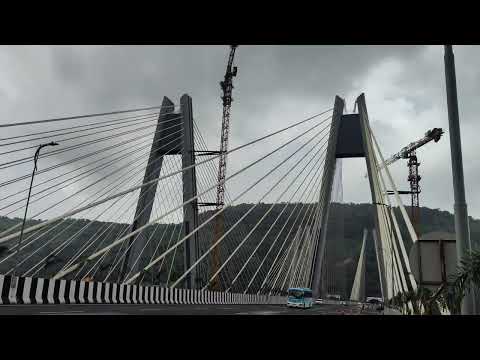
The most technically significant section of the expressway is the Missing Link — its actual official designation — the cable-stayed bridge at Khalapur, opened in 2022. Before this bridge was completed, the section between Khopoli and Khalapur added approximately 40 minutes to every Mumbai-Pune journey. The terrain in this pass is too steep and too narrow for a conventional road of expressway specification; the solution was to carry the highway across the valley on a cable-stayed structure threaded through the mountain pass itself. The engineering is visible and intentional — the pylons rise above the treeline, the cables descend at the angles the geometry requires, and the bridge places you briefly above the Ulhas River basin, which in the monsoon is completely filled with cloud below. The viewpoint at the midpoint of the crossing is one of the most dramatic roadside stops on any Indian highway.
On the eastern descent from the Ghats — the leeward side, where the Sahyadri range blocks the heaviest Arabian Sea moisture — the rain lightened and the sky opened. The Deccan plateau spread ahead toward Pune, drier and brighter than the coast behind. The highway straightened. Home was an hour away.
Plan Your Visit: Practical Guide to the Atal Setu Sunrise Drive
If you want to replicate this trip — the dawn bridge crossing, the quiet Mumbai hour, and the Ghats at their greenest — here is the information you actually need.
Best Season
July through September (monsoon) is the most dramatic for the Ghats and the most atmospheric for the dawn crossing, but also the most demanding to drive. November through February gives cleaner skies and better visibility but a more ordinary landscape. Avoid April–May (peak heat, expressway traffic intense, EV thermal stress).
Departure Timing
Leave Pune by 3:30–3:45 AM to arrive at Atal Setu between 6:15 and 6:45 AM. Sunrise time varies: check the specific date. The golden window is the 20 minutes before and after sunrise — the sky changes fast.
Toll and Route Notes
- Mumbai-Pune Expressway toll: approximately ₹330 one-way for a passenger car (Fastag); confirm current rates.
- Atal Setu toll: approximately ₹250 per direction (Fastag accepted).
- The Missing Link section has its own toll plaza — factor it into the return budget.
- Total road tolls for the round trip: approximately ₹1,200–1,400.
EV Charging Stops
- Oberoi Hotel, Nariman Point: Tata Power 60 kW DC. Best in-city fast charger for this route. Tata EZ Charge app required.
- Lonavala/Khalapur rest areas: Tata Power DC chargers available; useful if you want to top up mid-route rather than waiting for Mumbai.
- Petrol cars need no special planning — several fuel stations on the expressway.
What to See in Mumbai (with 3–4 Hours)
- Marine Drive: Walk the full 3.6 km from Nariman Point toward Chowpatty before 8 AM.
- Nariman Point promenade: The southern tip, facing the open sea, is quietest earliest.
- Sassoon Dock (Colaba): The early fish market is active 5–8 AM; vivid, real, worth seeing.
- Return via Atal Setu rather than the old Sion-Panvel Highway — the crossing in both directions in different light is worth the toll.
Key Takeaways
- Atal Setu (Mumbai Trans Harbour Link) is India's longest sea bridge at 21.8 km, crossing Thane Creek; it opened January 12, 2024, and takes approximately 12 minutes to cross at normal highway speeds.
- A 3 AM departure from Pune is not excessive — it is the precise timing required to arrive at the bridge during the sunrise window, before Mumbai traffic fills the approach roads.
- The Tata Punch EV completed 300 km Pune–Mumbai–Pune with one 45-minute charge stop costing ₹300, versus an estimated ₹2,000–2,500 for a petrol equivalent — a real-world eight-fold running cost advantage.
- The Western Ghats — a UNESCO World Heritage Site, with Deccan basalt dating to 65 million years and among the world's most biodiverse mountain ecosystems — are at their most visually dramatic during the July–September monsoon.
- The Missing Link cable-stay bridge at Khalapur (opened 2022) eliminated a 40-minute bottleneck and is one of the most engineering-notable road structures in peninsular India — the valley view from its midpoint, in the monsoon, is a genuine visual reward.
Frequently Asked Questions
How long does it take to cross Atal Setu by car?
Crossing Atal Setu (Mumbai Trans Harbour Link) takes approximately 10–14 minutes by car at the posted speed limit. The bridge is 21.8 kilometres long; the speed limit on the main span is 100 km/h, though actual crossing time varies slightly with traffic. The crossing is toll-collected at both ends — Fastag is accepted.
Can you do a Pune to Mumbai EV road trip on a single charge?
Not recommended without planning. The Pune-to-Mumbai distance via NH48 is approximately 150 km one way, which is within the Tata Punch EV Long Range variant's rated range of 421 km (MIDC), but real-world expressway speeds, monsoon conditions, and AC use reduce effective range considerably. Arriving with 21% after 160 km is a realistic scenario. The Tata Power 60 kW DC fast charger at the Oberoi Hotel, Nariman Point, is the most reliable Mumbai city charging option for this route and can restore 68 percentage points of charge in under an hour.
What is the best time to visit Atal Setu for sunrise photography?
Arrive at the Sewri/Navi Mumbai approach to Atal Setu between 6:00 and 6:20 AM to be on the main span during sunrise. In Mumbai, sunrise ranges from approximately 6:08 AM (June) to 6:52 AM (December), so adjust departure timing by season. The bridge faces west-to-east across Thane Creek, meaning the sky ahead lights first on the Mumbai side, with the colours most saturated in the 10–15 minutes immediately after the sun clears the horizon.
Is the Western Ghats drive on NH48 safe during the monsoon at night?
The Mumbai-Pune Expressway (NH48) is a high-standard six-lane divided highway with crash barriers, lane markers, and well-maintained pavement across the Ghats section. Monsoon night driving is demanding but not unusually hazardous compared to other Indian expressways, provided speeds are appropriate for visibility conditions. The main risk is heavy rain reducing visibility near Khopoli; built-in drainage on the expressway is generally effective. Truck traffic is lighter between 3–5 AM. The Missing Link bridge section includes lighting and is the most modern part of the route. Exercise normal monsoon precautions: reduce speed in heavy rain, use low beams in fog, and avoid stopping on the main carriageway.
The full drive — shot in 4K on a GoPro Hero 12 from the 3 AM departure through the dawn Atal Setu crossing, Marine Drive at sunrise, and the Western Ghats return — is on @explorenystream. Watch Atal Setu at Dawn | Pune to Mumbai Tata Punch EV | 4K GoPro Road Trip Vlog for the uncut road experience: the empty expressway in the rain, the exact moment the bridge appears across the water, and the Ghats in full monsoon green. If this kind of drive interests you, subscribe — there are more of them coming.