Atal Setu at Dawn | Pune to Mumbai Tata Punch EV | 4K GoPro Road Trip Vlog
August 28, 2026 — ny_wk
As an Amazon Associate I earn from qualifying purchases.
As an Amazon Associate I earn from qualifying purchases.
As an Amazon Associate I earn from qualifying purchases.
As an Amazon Associate I earn from qualifying purchases.
As an Amazon Associate I earn from qualifying purchases.
As an Amazon Associate I earn from qualifying purchases.
As an Amazon Associate I earn from qualifying purchases.
As an Amazon Associate I earn from qualifying purchases.
As an Amazon Associate I earn from qualifying purchases.
As an Amazon Associate I earn from qualifying purchases.
As an Amazon Associate I earn from qualifying purchases.
As an Amazon Associate I earn from qualifying purchases.
As an Amazon Associate I earn from qualifying purchases.
As an Amazon Associate I earn from qualifying purchases.
As an Amazon Associate I earn from qualifying purchases.
As an Amazon Associate I earn from qualifying purchases.
As an Amazon Associate I earn from qualifying purchases.
As an Amazon Associate I earn from qualifying purchases.
As an Amazon Associate I earn from qualifying purchases.
As an Amazon Associate I earn from qualifying purchases.
As an Amazon Associate I earn from qualifying purchases.
As an Amazon Associate I earn from qualifying purchases.
As an Amazon Associate I earn from qualifying purchases.
As an Amazon Associate I earn from qualifying purchases.
🛒 Recommended gear on AmazonDisclosure: some links above are affiliate links — if you buy through them I may earn a small commission at no extra cost to you. Thanks for supporting the channel!
As an Amazon Associate I earn from qualifying purchases.
As an Amazon Associate I earn from qualifying purchases.
As an Amazon Associate I earn from qualifying purchases.
Driving across the Atal Setu — India's longest sea bridge at 21.8 kilometres — at sunrise, in a Tata Punch EV, during peak monsoon, after a 3 AM departure from Pune: this is not a journey you plan casually. It is the kind of drive you either experience once and tell people about for years, or you watch someone else do it and immediately start looking at train times to Mumbai so you can turn around and drive back instead. This road trip from Pune to Mumbai and back covers two of India's most remarkable pieces of modern infrastructure — the Mumbai Trans Harbour Link (MTHL) and the Missing Link cable-stayed bridge on NH48 — wrapped inside 300 kilometres of monsoon highway that reminded me, forcefully, why the Western Ghats are a UNESCO World Heritage Site.
The 3 AM Decision: Why Leave Pune Before Dawn for Atal Setu?
The alarm went off at 2:55 in the morning. By 3:40, the Tata Punch EV was on the Mumbai-Pune Expressway and the city of Pune had already disappeared in the rearview mirror. The reasoning was straightforward: Atal Setu at sunrise requires you to be at the bridge approach in Navi Mumbai no later than 6:15 AM, which means leaving Pune no later than 4:00 AM during monsoon when visibility drops and speed drops with it. The math works out to a 3 AM departure if you want any margin at all.
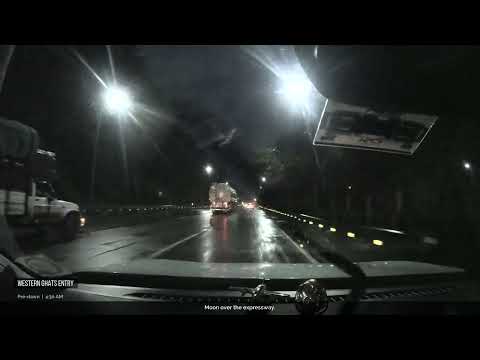
The other reason is simpler and more honest: the Mumbai-Pune Expressway in the pre-dawn monsoon is one of the strangest, most quietly spectacular stretches of road in India. India's first six-lane divided highway — 94 kilometres carved across the Sahyadri mountain range, opened in 2002 — normally carries a relentless stream of trucks, cars, and tempos. At 3:40 AM in August, it was empty. A wet black ribbon disappearing into headlight range, then nothing. The lane markers were sharp and white. The rain came properly around Khopoli.
Proper monsoon rain. The kind that puts your GoPro's weather sealing to work and makes the windshield wipers sound like a metronome set too fast. The road went dark except for the high beams and the painted lines. The moon — still up, still bright — was visible through gaps in the cloud on the far side of the Ghats. That particular shade of deep navy blue that precedes sunrise by about ninety minutes. The shade you only ever see when you are already moving, because anyone still in bed at that hour never gets to see it at all.
Atal Setu at Sunrise: Crossing India's Longest Sea Bridge in 12 Minutes
The Mumbai Trans Harbour Link — officially inaugurated as Atal Setu on 12 January 2024 — stretches 21.8 kilometres across Thane Creek, connecting Sewri in South Mumbai to Chirle in Navi Mumbai. At the time of writing, it holds the record as India's longest sea bridge and ranks among the longest in the world. The engineering took the better part of a decade: 177,000 metric tonnes of steel, more than 504 spans, a foundation driven through seabed that presented challenges typical of tidal estuarine conditions. From the road, it just looks like a line across the water.
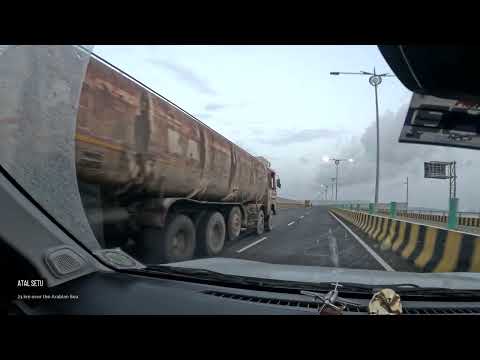
The approach matters. The road bends out of Navi Mumbai — the city grid falls away — and then the bridge appears ahead of you in a long straight. Sixteen lanes (it is a six-lane bridge in each direction with service lanes) stretching to a vanishing point somewhere between you and the western horizon. When we hit the bridge at 6:29 in the morning, the sky to the east behind us was already turning — that soft orange gradient that starts at the waterline and bleeds upward into the dark. On the water itself, the light was doubling: the real sunrise above, its reflection below, the bridge running between them like a ruled line in an architect's notebook.
The crossing takes approximately 12 minutes at the 100 km/h speed limit. Twelve minutes during which you are suspended between land and water with nothing around you except the bridge deck, the sea, and the sky. Thane Creek is not the open ocean — it is an estuary, tidal, a designated Ramsar Wetland important for migratory birds and mangrove ecology — but at that width and in that light it reads as ocean. The Mumbai skyline appears on the far side slowly, then all at once. The Bandra-Worli Sea Link's twin towers are visible to the north on clear days; in the monsoon they were somewhere in the haze, present but not defined.
The Atal Setu toll for a car (as of 2024-25) is approximately ₹250 per single crossing. The bridge has no emergency stopping on the main carriageway — if your vehicle fails, you use the service lane and call for assistance. For EV drivers specifically: there are no charging points on the bridge itself, so ensure you have comfortable range before you enter.
Key engineering facts about Atal Setu (MTHL)
- Total length: 21.8 km (16.5 km over water, remainder on land approaches)
- Lanes: 6 lanes (3 each direction) with emergency/service lanes
- Design speed: 100 km/h
- Opened: 12 January 2024, inaugurated by Prime Minister Narendra Modi
- Connects: Sewri (Mumbai) to Chirle (Navi Mumbai)
- Time saved: Reduces the Sewri-to-Chirle commute from approximately 60 minutes to under 20 minutes
- Environmental clearance: Required specific design accommodations for flamingo habitats in Thane Creek
South Mumbai Before 7 AM: Marine Drive, Nariman Point, and the City That Isn't Awake Yet
The bridge deposits you into the heart of the Mumbai metropolitan machine, but at 7 AM on a monsoon morning the machine has not fully started. We came through South Mumbai slowly — not for lack of roads but because there was no reason to hurry, and because the city at that hour is worth looking at.
Marine Drive — officially Netaji Subhash Chandra Bose Road — is 3.6 kilometres of seafront promenade completed in 1940, running from Nariman Point in the south to Babulnath in the north along the shore of Back Bay, Arabian Sea. The art deco buildings that frame it on the inland side are a mid-century architectural statement that the city has never replicated since, and probably could not if it tried. At 7 AM the road itself is open and fast; the footpath carries its early crowd — runners, walkers, a few people simply standing at the sea wall looking out.
Mumbai in the monsoon at 7 AM is genuinely quiet. That is the accurate word. Not empty — there are people, cars, vendors setting up — but the scale of the city works in your favour at that hour in a way it absolutely does not at 9 AM or 11 AM. The pavements are wet and reflecting. The air smells of rain and sea simultaneously. The sound level is what you would hear in a medium-sized town on a quiet afternoon, not a city of twenty million. It lasts perhaps ninety minutes, this particular window, before the traffic logic reasserts itself and Mumbai becomes Mumbai again.
Nariman Point — Mumbai's original financial district, built entirely on land reclaimed from the Arabian Sea in the 1970s — sits at the southern tip of the Marine Drive arc. The buildings that face the water here are among the most photographed in the city: the NCPA complex, Oberoi Trident, the Air India building. We had documents to submit to a consulate on one of the streets behind Nariman Point — the specific reason for the 3 AM departure — and we were done by 10:45 AM, two hours ahead of the scheduled appointment window. Early departures tend to have that effect.
Tata Punch EV on a 300 km Round Trip: Battery, Range, and the Oberoi Fast Charger
Range anxiety on an EV road trip from Pune to Mumbai is a real concern, and worth addressing honestly rather than optimistically. The Tata Punch EV — in its long-range variant — offers a claimed range of around 421 km (MIDC cycle). Real-world highway range, especially at expressway speeds with air conditioning, typically comes in considerably lower. The Pune-to-Mumbai distance via the expressway and Atal Setu is approximately 150 km one way, making a 300 km round trip achievable in theory — but monsoon driving, variable speeds, and elevation changes across the Ghats all affect the discharge curve.
By the time we finished in South Mumbai at 10:45 AM, the battery was at 21%. This is the point where the decision to charge or to attempt the return on residual becomes real. We charged.
The Oberoi Hotel on Marine Drive — just a few minutes from Nariman Point — has a Tata Power 60 kW DC fast charger in its parking level. This is a public charger; you do not need to be a hotel guest. The Punch EV went from 21% to 89% in under an hour. Total cost: approximately ₹300. That is the entire energy cost — Mumbai to Pune and back, 300 km — for the whole journey. The return trip had sufficient buffer to cross the Ghats, descend to the Deccan plateau, and reach Dhanori, Pune with comfortable margin.
For EV drivers planning Pune to Mumbai via Atal Setu: the Oberoi fast charger is the most conveniently located option in South Mumbai for this specific route. Tata Power charging stations are also available at Phoenix Palladium (Lower Parel) and several locations in BKC, but the Oberoi placement is optimal if you are spending time at or near Marine Drive before returning.
EV charging points on the Pune-Mumbai corridor
- Khalapur (near the toll plaza): Limited charging, primarily slow AC options
- Navi Mumbai: Multiple Tata Power and ChargeZone stations in the CBD
- Oberoi Hotel, Marine Drive: 60 kW DC fast charger (Tata Power), public access
- BKC / Bandra: Multiple fast chargers including Tata Power and Charge+Zone
- Phoenix Palladium, Lower Parel: Fast charger bank, mall parking
The Return Drive: Missing Link Bridge, Western Ghats, and the UNESCO Biodiversity Corridor
The return crossing of Atal Setu at 10:45 AM is a completely different experience from the dawn crossing. The bridge is the same. The sea on both sides is the same 21.8 kilometres of estuary. But the light has turned flat and dramatic in a different register — not the warm orange of sunrise but the steel-grey luminosity of a monsoon sky fully built up, the clouds three-dimensional and dark at the base, the bridge white against them. Mumbai shrinks in the rear view mirror. The city does not look diminished by the distance; it looks concentrated, a dense dark line on the western horizon that the bridge is slowly pulling you away from.
The return on the Mumbai-Pune Expressway goes east, which means ascending through the Western Ghats — the Sahyadri range — into Maharahstra's interior. The expressway here is genuinely remarkable engineering. Opened in 2002 as India's first six-lane divided highway, it follows the natural contours of the Ghats closely enough that the geometry never feels imposed on the landscape — it feels discovered within it. The road curves where the ridgeline curves. The tunnels are short. The viaducts are long and low. The result, in peak monsoon, is a driving experience that is difficult to adequately describe to anyone who has only seen the Expressway at capacity in summer: the hills on either side are green in a way that does not exist at any other time of year.
This is 65-million-year-old Deccan basalt covered in monsoon vegetation so dense and so sudden that it reads as impossible, as if the rock itself is flowering. The Western Ghats — a UNESCO World Heritage Site since 2012 — are recognised as one of the eight hottest biodiversity hotspots on Earth. More than 7,400 species of flowering plants, 139 mammal species, 508 bird species, 179 amphibian species — a significant proportion found nowhere else on the planet. None of that is legible from the expressway. What is legible is the colour, and the clouds, and the fact that you are driving through something that has been here for sixty-five million years and will be here long after the road is gone.
The Missing Link: NH48's Cable-Stayed Bridge at Khalapur
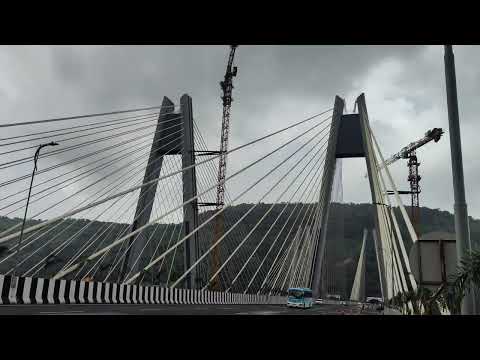
The Missing Link bridge — its actual designation in infrastructure documents, not a nickname — is a cable-stayed bridge on National Highway 48 that passes through the hardest section of the Sahyadri between Khopoli and Khalapur. It opened in 2022. Before it was built, this section of the Ghats — where the terrain makes a conventional ground-level road geometrically impossible — added approximately 40 minutes to every single Mumbai-Pune journey. The solution was to take the road into the air: a cable-stayed structure threaded through a mountain pass, with the valley of the Ulhas River basin below.
In the monsoon, the Ulhas River basin is completely filled with cloud. Looking down from the midpoint viewpoint — where we stopped, turned off the engine, and let the GoPro run — the valley is not visible. It is a sea of white moving slowly below, the tributary ridgelines rising out of it like islands, the bridge itself the only man-made object for kilometres in any direction. The engineering is invisible from here. From here it is simply a place to stand and look down into a cloud.
Beyond Khalapur and the descent off the Ghats, the landscape changes abruptly. The Sahyadri range acts as a moisture barrier for the Arabian Sea's monsoon systems — the heavy rainfall and dense vegetation of the western slope give way, on the eastern Deccan plateau side, to a drier, more open environment. The sky opens up. The highway straightens. The rain becomes lighter, then stops. The road runs east through farmland and industrial corridors, the elevation dropping steadily toward the Pune basin.
We were back in Dhanori, Pune, by 2 PM. 300 kilometres. Ten and a half hours door to door. One charge stop: 60 kW fast charger, 45 minutes, ₹300.
Plan Your Visit: Pune to Atal Setu by EV — A Practical Guide
If the dawn crossing of Atal Setu has moved up your list after reading this, here is the practical information you need to actually do it.
Best time for the Atal Setu sunrise crossing
Monsoon season (June-September) offers the most dramatic skies and the emptiest expressway at pre-dawn hours, but also the highest chance of low visibility. Winter (November-February) gives cleaner air and a more golden sunrise, but the expressway is busier even at 4 AM as more vehicles run the Pune-Mumbai corridor in cooler weather. Monsoon is the most atmospheric; winter is the most reliable.
Departure time from Pune
Target the bridge at approximately 6:15-6:30 AM for optimal sunrise light. Work backwards: the drive from Pune to the Atal Setu approach (Navi Mumbai) is roughly 2.5-3 hours including the Ghats section. A 3:15-3:30 AM departure from Dhanori or Pune central gives comfortable margin in monsoon conditions. The expressway is genuinely empty before 4 AM.
EV-specific preparation
- Start with a full charge from Pune (100% if possible)
- The one-way distance is approximately 150 km; plan your charge stop for the return
- Oberoi Hotel Marine Drive Tata Power charger (60 kW DC) is the most convenient South Mumbai option for this route
- Charge to 80-85% for the return (sufficient for Pune including the Ghats climb)
- Expressway AC usage significantly affects range — budget conservatively
What to budget
- Atal Setu toll: ~₹250 per car per crossing (₹500 return)
- Mumbai-Pune Expressway toll: varies by entry/exit point, approximately ₹300-400 round trip
- EV charging (Oberoi, 21-89%): approximately ₹300
- Total running cost for a 300 km EV round trip: under ₹1,200 including all tolls and charging
Marine Drive and Nariman Point timing
If you are on the bridge at 6:30 AM, you reach South Mumbai by 7:00-7:15 AM. Marine Drive before 8:30 AM in monsoon is genuinely worth the early departure — the promenade is walkable, the traffic is light, and the scale of the city is on your side. By 9:30 AM it is a different world.
Key Takeaways
- Atal Setu (Mumbai Trans Harbour Link) opened 12 January 2024 as India's longest sea bridge at 21.8 km across Thane Creek; the crossing takes approximately 12 minutes at the 100 km/h limit.
- A 3 AM departure from Pune is the correct answer for a sunrise Atal Setu crossing — the Mumbai-Pune Expressway is genuinely empty, and the pre-dawn monsoon drive across the Ghats is one of the most unusual road experiences in India.
- The Tata Punch EV handles the 300 km Pune-Mumbai-Pune round trip on a single fast-charge stop; the Oberoi Hotel Marine Drive Tata Power 60 kW charger (public access) is the most convenient South Mumbai option, at approximately ₹300 for a 21-89% fill.
- The Missing Link cable-stayed bridge on NH48 at Khalapur (opened 2022) cuts through the hardest section of the Sahyadri and eliminates a 40-minute detour that every Mumbai-Pune driver endured for decades — in monsoon, the view down into the Ulhas basin cloud-sea is extraordinary.
- The Western Ghats UNESCO World Heritage Site — 65-million-year-old Deccan basalt, one of eight global biodiversity hotspots — is best experienced from this corridor in July-September, when the monsoon turns the range an impossible shade of green that no other season replicates.
Frequently Asked Questions
How long does it take to cross Atal Setu (Mumbai Trans Harbour Link)?
The crossing of Atal Setu takes approximately 12 minutes at the 100 km/h speed limit. The bridge is 21.8 km long (16.5 km over water), connecting Sewri in South Mumbai to Chirle in Navi Mumbai. The toll for a private car is approximately ₹250 per single crossing.
Can you do a Pune to Mumbai road trip in a Tata Punch EV without multiple charge stops?
Yes. The Pune-Mumbai one-way distance via NH48 and Atal Setu is approximately 150 km. Starting with a full charge from Pune, the Tata Punch EV can complete the one-way journey comfortably and return after a single fast-charge stop in Mumbai. The Oberoi Hotel on Marine Drive has a public-access Tata Power 60 kW DC fast charger; a 21-to-89% charge takes under an hour and costs approximately ₹300.
What is the Missing Link bridge on the Mumbai-Pune Expressway?
The Missing Link is a cable-stayed bridge on NH48 between Khopoli and Khalapur in the Western Ghats, opened in 2022. Before its construction, this section of the Sahyadri range made a conventional road impossible and added approximately 40 minutes to every Mumbai-Pune journey. The bridge passes through a mountain pass with the Ulhas River basin below; in monsoon, the valley is filled with cloud.
What is the best time to visit Atal Setu for a sunrise crossing?
For a sunrise crossing of Atal Setu from the Navi Mumbai side, aim to reach the bridge approach between 6:00 and 6:45 AM — sunrise during monsoon months (July-August) occurs around 6:20-6:35 AM in Mumbai. From Pune, this requires a 3:00-3:30 AM departure. Monsoon offers the most dramatic skies; winter (November-February) offers cleaner visibility and a more golden light.
The complete drive — including the GoPro Hero 12 4K footage of the dawn crossing, the full Atal Setu sequence both ways, the Missing Link bridge viewpoint, and the Marine Drive walk — is in the video above. Watch Atal Setu at Dawn | Pune to Mumbai Tata Punch EV | 4K GoPro Road Trip Vlog on @explorenystream. If the drive is the kind of thing you would do — or would have done before you watched someone else do it first — subscribe. There are more of these on the way.