Overnight Stay at Jadhavgadh Fort Near Pune | 316-Year-Old Maratha Heritage Hotel | Full Vlog
August 28, 2026 — ny_wk
🛒 Recommended gear on AmazonDisclosure: some links above are affiliate links — if you buy through them I may earn a small commission at no extra cost to you. Thanks for supporting the channel!
As an Amazon Associate I earn from qualifying purchases.
Jadhavgadh Fort near Pune is a 316-year-old Maratha fortress turned heritage hotel — and spending a night inside its walls is the most disorienting, spine-tingling, completely unforgettable thing I have done off a volleyball court. I play most weekends in Dhanori, I live for the grind, but this trip to Saswad rewired something in me. Here is every detail you need before you go — the drive, the history, the activities, the rituals, and one Sahyadri sunrise I still think about every time I set a ball.
🛒 Today's Picks on Amazon
As an Amazon Associate I earn from qualifying purchases.
Why Jadhavgadh Fort Is the Weekend Getaway Pune Has Always Deserved
We talk about weekend trips from Pune the way we talk about restaurant recommendations — the same five names cycle endlessly and nobody digs deeper. Lonavala, Mahabaleshwar, Alibaug. I do not have anything against those places, but when a 316-year-old Maratha fort sits 48 km from Dhanori, converted into a heritage hotel where you actually sleep inside the stone walls that once sheltered Peshwa commanders, you start to feel like the city has been keeping a secret from you.
Jadhavgadh Fort Heritage Resort in Saswad, Pune district, is that secret. The drive out is part of the experience itself. Leave Pune behind and follow the road through Saswad town; the gradient rises almost imperceptibly at first, the city thins out, and the Western Ghats — the Sahyadri range — step forward one ridge at a time. Terrace farms catch the afternoon light, mountain ridges cut clean lines against the sky, and the air temperature drops noticeably as you climb. By the time the road narrows and steepens toward the fort, you are already in a different world.
That transformation — from Pune's chaos to the quiet of the Sahyadri foothills — is not a side effect of the trip. It is the trip. The fort is only about an hour from the city, but it feels like a full day's worth of mental distance. For a weekend warrior who spends every Saturday chasing rallies on a volleyball court, that decompression is gold.
The Darwaza: What Maratha Military Engineering Looks Like Up Close
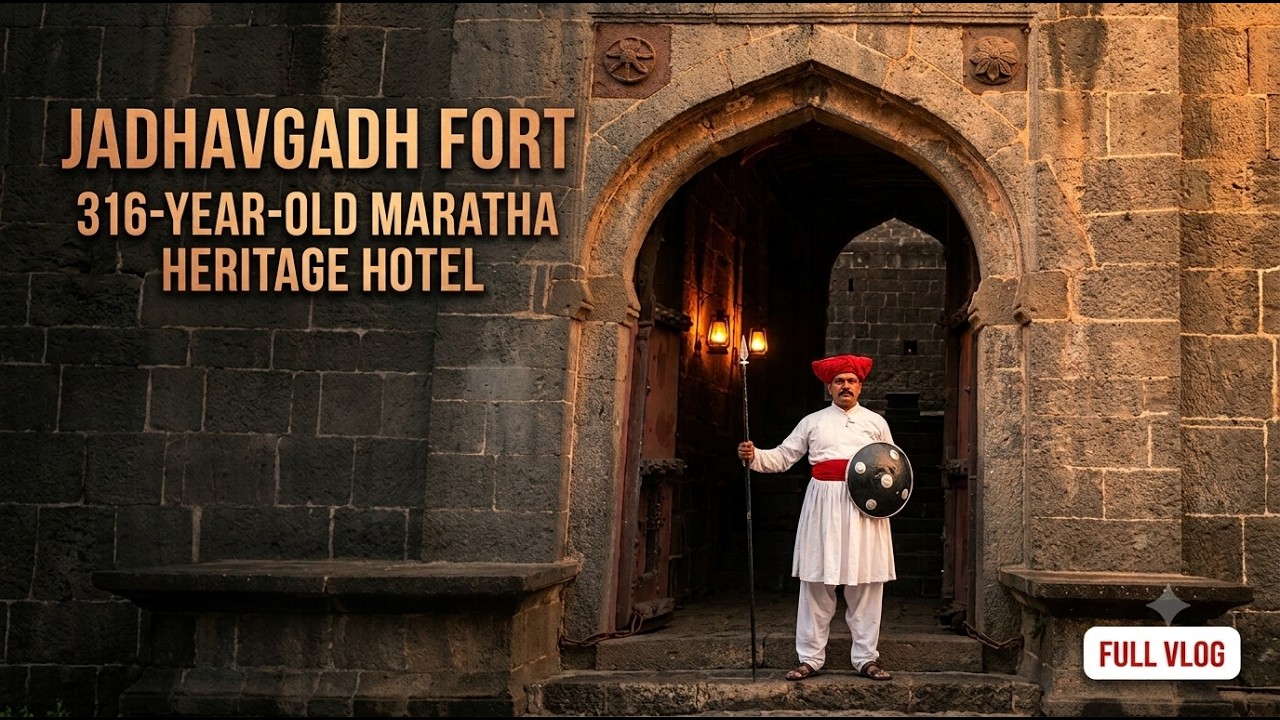
Nothing prepares you for the gate. I have seen photographs, I had read the history, and I still stopped walking when the Darwaza — the main entrance gate — rose into view around the last bend of the approach road. Built in 1710 under the patronage of the Jadhav clan, this gateway is one of the finest surviving examples of Maratha military architecture in the Deccan.
Look at it carefully and you see the engineering logic immediately. Twin bastions flank the arch on both sides, angled so that defenders on the ramparts above could cover every approach angle with crossfire. The iron spikes studded across the lower face of the gate were specifically designed to stop war elephants — because a war elephant was essentially a battering ram with legs, and the Marathas had watched other forts fall to exactly that tactic. They were not going to make the same mistake.
Then look above the military hardware and you find something completely unexpected: lotus flower carvings and geometric relief patterns cut with extraordinary precision into the stone around the archway. Artistry flourishing inside a structure built entirely for war. That contradiction — beauty and lethality occupying the same stone — is the essential Maratha aesthetic, and you see it everywhere once you know to look for it.
- Twin bastion design for overlapping defensive fire from rampart positions
- Iron spike facing to deter elephant charges — a documented Maratha defensive tactic
- Lotus and geometric carvings above the arch, carved by Maratha craftsmen at the height of their empire
- Strategic orientation — the gate faces away from the prevailing attack corridor, forcing any approaching army to expose its flank
Stand in that gateway long enough and you stop being a tourist. Generals walked through here. Ambassadors negotiated inside. The Peshwas of the Maratha Empire — the de facto rulers who administered the empire at its greatest extent — used this fort as a working outpost of real power, not a ceremonial residence.
316 Years of Maratha History — and How the Heritage Hotel Got It Right
The Sahyadri range has sheltered kingdoms, guided trade caravans, and watched armies come and go for millennia. Jadhavgadh Fort was built in 1710 by the Jadhav family — a Maratha noble lineage with deep roots in the Deccan — and its position on a quiet ridge above the river valley below was no accident. Control of the high ground meant control of the trade routes threading through the ghats, and control of water meant the ability to outlast any siege.
The fort's history spans three distinct political eras. Under the Maratha Empire, it functioned as a military and administrative stronghold. After Maratha power declined, the Peshwas — the Brahmin minister-administrators who effectively ruled the empire in the 18th century — maintained the fort's importance. Then came the British East India Company, which absorbed the region after the Third Anglo-Maratha War of 1818 and left its own administrative marks, though the fort's Maratha character never really wavered through any of it.
Converting a genuine 17th-century military fortification into a functioning luxury hotel without destroying what makes it worth visiting is an architectural and conservation challenge that most developers get catastrophically wrong. Here, they got it right. No original structure was demolished. No new rooms were built by cutting through old walls. The conversion worked with the existing stone — adding modern plumbing, lighting, and climate systems inside spaces that were already there, so the fort's bones remain exactly as the Maratha builders left them.
Walk through the inner fort's interconnected courtyards and you move through chambers that have barely changed in three hundred years. Carved wooden pillars still hold up the roofs of Darbar halls where nobles once debated strategy. Arched doorways frame sightlines across courtyards that were designed for both daily movement and rapid defensive repositioning. Painted ceilings from the 18th century survive in the private chambers — faded in places, vivid in others, completely authentic everywhere.
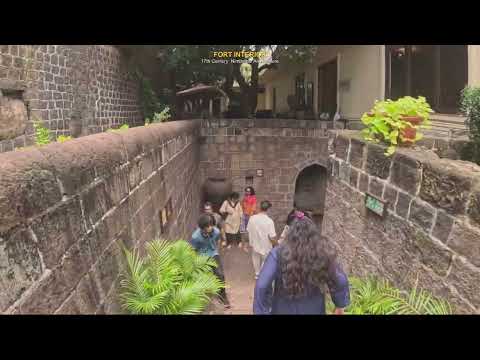
The Bavdis — the ancient step wells carved directly into the rock — still hold water. Descend the stone steps and you are looking at Maratha hydraulic engineering: a system of cisterns, channels, and catchment pools carved to guarantee water security through any siege, however long. The Marathas were not just warriors; they were engineers who understood that a fortification without a reliable water supply was just a cage waiting for a siege to reveal it.
The ramparts deserve their own paragraph. They stretch for over two kilometres and stand up to twelve metres high at their tallest points. Walk the full circuit at your own pace and you are doing what Maratha soldiers did on patrol — scanning the valley floor below, reading the terrain, tracking which ridge hides which approach. On a clear morning, the strategic logic of the entire site becomes obvious: from up here, you saw everything coming, long before it arrived.
Archery, Zipline, and the Maratha Warrior Experience
I will be honest: when I saw "archery" on the activities list, I expected the kind of watered-down tourist version you find at every adventure park — a safety briefing, a foam target, and a staff member who does most of the work. What I found at Jadhavgadh was completely different, and the difference is context.
Drawing a bow within walls where Maratha archers actually trained carries a physical weight that a modern range cannot manufacture. Mounted cavalry and skilled archers were the backbone of the Maratha military machine — the light cavalry that made Shivaji Maharaj's guerrilla campaigns possible, and the archers whose accuracy on fortification walls allowed a smaller garrison to hold against a numerically superior attacking force. Stand in the position those archers stood, look out over the same valley they watched, and the sport stops being sport for a moment.
The zipline launches from one of the high ramparts and spans approximately 300 metres over the valley below. For the few seconds of the run, you are looking down from the same height Maratha sentinels looked down from — except you are moving fast and the valley is dropping away beneath you at speed. It is the sharpest possible contrast: medieval stone, modern adrenaline, and the Sahyadri hills rolling out in every direction. I have played volleyball in some intense matches. I have never felt anything quite like those few seconds over the valley.
Beyond archery and the zipline, the fort has developed its grounds into a serious activity zone — one that uses the 300-year-old landscape as an active backdrop rather than a passive backdrop. The combination of authentic historical setting and modern adventure infrastructure is genuinely unusual in Maharashtra tourism, and it works because the scale of the fort is large enough to absorb everything without feeling crowded.
The Gadh Bandh Ritual, Lavani Performance, and a Sunrise That Stays With You
Staying overnight changes the trip from a day excursion into a full immersion, and the evening programme is the reason you book the overnight stay rather than just a day visit.
The Gadh Bandh ceremony — the traditional gate-closing ritual — takes place at dusk. It is not a recreated performance for tourists; it is a living practice rooted in the same operational logic that governed fort life for centuries. When the massive Darwaza gates close for the night, the weight of the ceremony is real. The fort seals. The outside world disappears. You are genuinely inside the walls, which is a very different feeling from visiting them.
The Lavani folk dance performance that follows is one of Maharashtra's oldest and most sophisticated art forms — a tradition born in the Peshwa courts and performed for Maratha nobility in exactly these kinds of settings. Watching it inside the fort's courtyard, with stone walls amplifying the percussion and the night sky as the ceiling, gives you a sense of the cultural richness that existed inside these military structures. The Maratha Empire was not just a war machine. It was a civilization with a distinct artistic vocabulary, and Lavani is one of its most alive surviving expressions.
Then there is the sunrise. I am a morning person by necessity — volleyball tournaments start early, so early mornings and I have an understanding — but the sunrise over the Deccan plateau from the Jadhavgadh ramparts is something else. The valley floor picks up the first light before the ridges do, so for a few minutes you are watching the landscape illuminate from the bottom up, the mist thinning as the temperature rises, the surrounding hills going from silhouettes to solid reality. Maratha commanders stood at these same parapets at dawn and read the terrain for approaching threats. I stood there and thought about how small the problems in my daily routine actually are.
That is what a great overnight trip does. It does not just show you something beautiful. It briefly reorganises your sense of proportion.
Planning Your Jadhavgadh Overnight Stay: What to Know Before You Book
The practical details matter when you are planning this kind of trip, so here is what I wish I had known in advance.
- Distance and route: Jadhavgadh Fort is approximately 48 km from central Pune, routed through Saswad town and into the Sahyadri foothills. Plan for about one hour of driving from the Dhanori / Pune city area, more on weekends when Saswad town traffic builds.
- Best time to visit: The post-monsoon period (October through February) gives you the clearest views from the ramparts and the most comfortable temperatures. Monsoon visits are atmospheric — mist in the Sahyadri is extraordinary — but some outdoor activities are restricted. Summer months get warm but the fort's stone walls provide shade and the altitude keeps temperatures manageable.
- Overnight vs. day visit: The day visit lets you see the architecture and do the activities. The overnight stay lets you experience the Gadh Bandh ceremony, the Lavani performance, and the sunrise. The difference between the two is not incremental — it is categorical. Book the overnight.
- Activities available: Archery, zipline, heritage walks on the ramparts, and access to the museum and Bavdi step wells. Activity schedules vary — confirm what is running during your visit when you book.
- Photography: The fort is extraordinary at golden hour. The combination of warm light, ancient stone, and the Sahyadri ridges behind makes this one of the most photographable locations in Pune district.
- Who should go: History enthusiasts, adventure travellers, families, couples, and anyone who has started to feel like Pune's usual weekend options have gone stale. This trip works for all of them.
Key Takeaways
- Jadhavgadh Fort is 48 km from Pune — close enough for a weekend trip, remote enough to feel like a full escape into the Sahyadri hills.
- Built in 1710, the fort preserves genuine Maratha military architecture including the iron-spiked Darwaza gate, twin defensive bastions, ancient Bavdi step wells, and two kilometres of intact ramparts up to twelve metres high.
- The heritage hotel conversion preserved every original structure — no walls demolished, no historic rooms erased — making this one of the most authentic fort-stay experiences in Maharashtra.
- The overnight programme — Gadh Bandh gate-closing ritual, Lavani folk dance performance, and a dawn sunrise from the ramparts over the Deccan plateau — justifies the overnight stay completely; a day visit alone misses the best of it.
- Activities including archery and a 300-metre zipline over the valley add modern adventure to the historical setting, making it work as both a heritage and an adventure destination simultaneously.
Frequently Asked Questions
How far is Jadhavgadh Fort from Pune city?
Jadhavgadh Fort Heritage Resort is approximately 48 km from Pune city, situated near Saswad town in the Sahyadri foothills. The drive takes roughly one hour under normal traffic conditions, following the route through Saswad and up into the western Ghats.
Is Jadhavgadh Fort actually a heritage hotel you can stay overnight in?
Yes. The fort has been converted into a functioning heritage hotel while preserving all original Maratha-era structures. Guests stay in rooms built within the original stone fort walls and have access to the ramparts, historic courtyards, Darbar halls, and Bavdi step wells — plus evening cultural programmes including the Gadh Bandh ceremony and Lavani folk dance performance.
What is the Gadh Bandh ceremony at Jadhavgadh Fort?
The Gadh Bandh is the traditional gate-closing ritual performed at dusk each evening at Jadhavgadh Fort. Rooted in the operational practice of Maratha-era fort life, the ceremony involves formally closing the historic Darwaza gate for the night. It is one of the cultural highlights of the overnight stay and gives guests a lived sense of what fort life actually felt like under Maratha administration.
What adventure activities are available at Jadhavgadh Heritage Resort?
Jadhavgadh offers medieval archery within the historic fort walls, a zipline spanning approximately 300 metres launched from one of the high ramparts over the Sahyadri valley, and guided heritage walks along the 2-km rampart circuit. Activity availability may vary seasonally — confirm with the resort when booking.
If you have been bouncing between the same Pune weekend destinations and wondering when something genuinely different is going to show up — Jadhavgadh Fort is your answer. Three centuries of Maratha history, twelve-metre ramparts with views across the Deccan, archery and a valley zipline, a gate-closing ritual at dusk, Lavani under the stars, and a sunrise that makes the whole drive out feel like the best decision you made all month.
Watch the full overnight stay — every ritual, every view from the ramparts, and the complete Sahyadri sunrise — in Overnight Stay at Jadhavgadh Fort Near Pune | 316-Year-Old Maratha Heritage Hotel | Full Vlog on @explorenystream. Subscribe to the channel so you never miss the next Pune-area discovery — there are more of them than this city lets on.