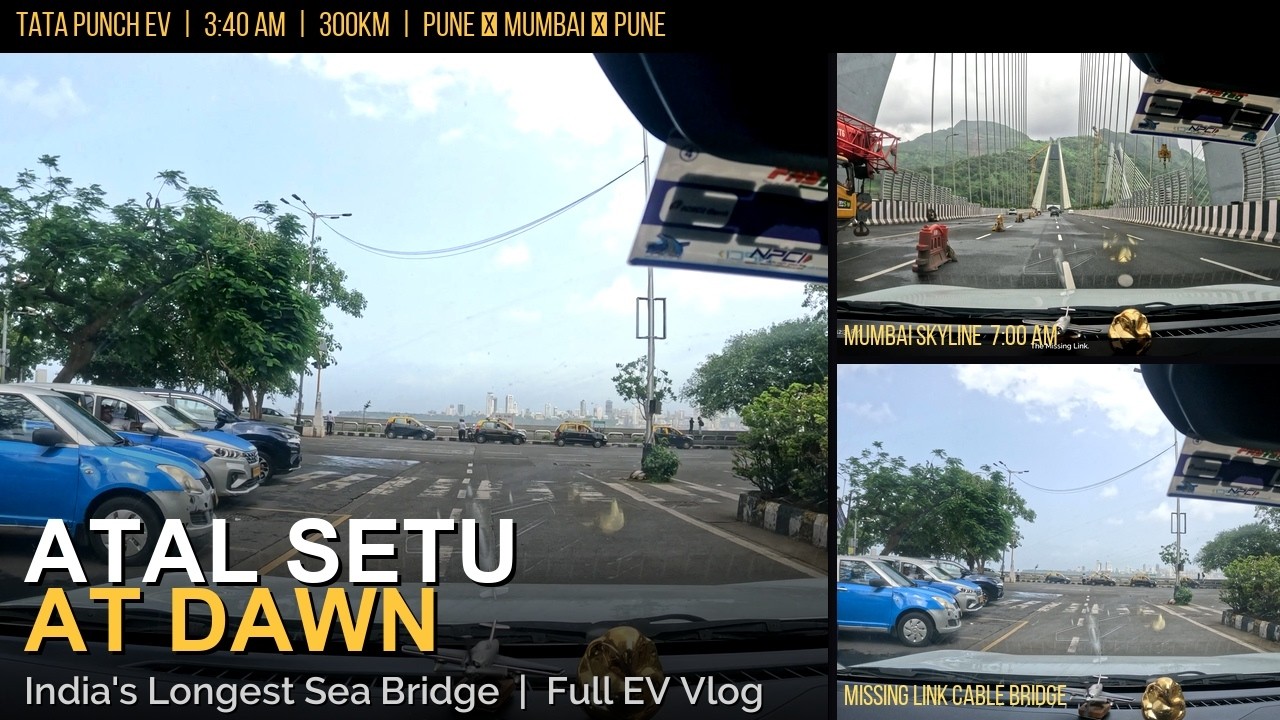
Pune to Mumbai in a Tata Punch EV | 300km Same-Day Road Trip | Atal Setu | Missing Link
August 28, 2026 — ny_wk
🛒 Recommended gear on AmazonDisclosure: some links above are affiliate links — if you buy through them I may earn a small commission at no extra cost to you. Thanks for supporting the channel!
As an Amazon Associate I earn from qualifying purchases.
A 300-kilometre same-day road trip from Pune to Mumbai and back in a Tata Punch EV — crossing Atal Setu at dawn, walking Marine Drive before the city woke up, and threading the Missing Link cable-stayed bridge through peak monsoon on the return — is hands down one of the most electric drives you can do in Maharashtra right now. I know, because I've just done it, and I'm still thinking about it three days later.
🛒 Today's Picks on Amazon
As an Amazon Associate I earn from qualifying purchases.
If you've been wondering whether the Tata Punch EV can handle a proper intercity run — not a city-hop, but a real, loaded, there-and-back-same-day mission — this is the answer you were looking for. Spoiler: it handled it. More than handled it. But the engineering, the roads, and the sheer drama of the Western Ghats in monsoon almost stole the show.
The 3:40 AM Departure from Dhanori, Pune — Why Leave That Early?
Anyone who plays volleyball in Dhanori knows the neighbourhood before sunrise. Early court time, the smell of wet grass after the monsoon shower, that quiet hour before the city catches up with itself. Leaving at 3:40 AM felt completely natural to me — it's the same weekend warrior instinct that gets you to the court before the heat arrives.
The logic behind the pre-dawn start was simple and strategic. The Mumbai-Pune Expressway is a different beast at 3 AM. India's first six-lane expressway — 94 kilometres of civil engineering muscle carved across the Western Ghats — carries one of the heaviest freight and commuter loads on the subcontinent during daylight hours. Trucks in every lane, aggressive overtakers, the grinding stop-start near Khopoli. At 3:40 in the morning? Empty. Completely, surreally, beautifully empty.
I pulled out of Dhanori with the Tata Punch EV on a full charge. The rain was already steady. Monsoon Pune at that hour has its own particular atmosphere — streetlights haloed in mist, autorickshaws tucked under flyovers, the sound of water on tarmac. By the time I cleared the last traffic signal near Hadapsar and hit the expressway approach, the city had completely fallen away behind me.
The Mumbai-Pune Expressway opened in 2002 and fundamentally reshaped the economic relationship between the two cities. Before it, the old NH4 through Khandala and Lonavala was a four-hour ordeal. The expressway cut that to under two in good conditions. What it did to the early-morning solo driver in a quiet EV, in the monsoon, is something different again — it gave me an almost meditative ninety-four kilometres of perfect road.
The Tata Punch EV was running whisper-quiet. That's one of the things you don't fully appreciate until you're on a deserted expressway at 4 AM — the silence inside an electric car is almost cinematic. Rain on the windshield, wiper on slow, and nothing else. The regenerative braking system was gently topping up the battery on every gentle downhill, the range readout ticking up by a kilometre here and there. This is how EV driving should feel.
The Western Ghats Before Dawn — A UNESCO World Heritage Site in Full Monsoon
The Western Ghats section of the expressway is the stretch between roughly Khopoli and the descent toward Panvel. Sixty-five million years old. Basalt formed from the Deccan Traps volcanic eruptions that coincided with the mass extinction at the end of the Cretaceous period. One of the eight hottest biodiversity hotspots on earth. A UNESCO World Heritage Site since 2012. All of that geological and ecological weight is there in the rocks and the waterfalls and the dripping forest — and at 4 AM in August, you feel every bit of it.
Even in darkness, the Ghats announce themselves. The temperature dropped three or four degrees as I climbed. The rain intensified. In my headlights I could see the roadside waterfalls — temporary cascades that only exist in peak monsoon, spilling off the basalt cliffs and across the emergency lanes. The visibility compressed to about sixty metres of illuminated rain. I slowed down. The Punch EV's headlights are genuinely excellent for a car in its price bracket, and I needed every lumen.
There's something primal about driving through those hills in the dark. The Western Ghats runs 1,600 kilometres from Gujarat to Kerala, separating the narrow Konkan coastal strip from the broad Deccan Plateau where Pune sits. The plateau is drier, more open, historically the land of the Marathas. The Konkan side is wet, dense, ancient. Every time you cross the Ghats on the expressway, you're crossing a genuine biogeographical boundary. The flora on the western slopes — the ferns, the mosses, the shola patches — are biologically distinct from what grows twenty kilometres east on the plateau.
I made a mental note about the temperature drop: it matters for EV range. Cold air, sustained highway speed, headlights and wipers on — all of these pull at the battery harder than the optimistic range estimate would suggest. I was watching the state of charge more carefully on the climb than I had on the flat Pune approach. The descent toward Navi Mumbai would help, regenerative braking clawing some of it back.
By the time I reached the Panvel area and the gradient flattened out, first light was just beginning to grey the eastern sky. The Ghats were behind me. Navi Mumbai was ahead. And then — the thing I'd actually left at 3:40 AM to see.
Atal Setu at Sunrise — India's Longest Sea Bridge and What It Actually Feels Like
The Mumbai Trans Harbour Link, officially named Atal Setu after former Prime Minister Atal Bihari Vajpayee, was inaugurated on January 12, 2024, by Prime Minister Narendra Modi. It is 21.8 kilometres long — India's longest sea bridge and one of the longest in Asia. It carries six lanes of traffic across Thane Creek, connecting Sewri in Mumbai proper to Nhava Sheva on the Navi Mumbai side.
The engineering behind it took close to a decade from groundbreaking to ribbon-cutting. The bridge is a continuous prestressed concrete viaduct — not a single dramatic span, but an extraordinarily long, low-profile crossing that sits just high enough above the water to let smaller vessels pass beneath. The piles go deep into the creek bed. The construction had to account for tidal variation, ship traffic, cyclone loads, and the notoriously difficult soft sediment under Thane Creek.
I hit the toll plaza at 6:29 AM. The sun was not fully up but the sky was doing something extraordinary — that deep blue-grey monsoon pre-dawn where the clouds hold the light differently. I paid the toll and accelerated onto the bridge. Six lanes. No traffic except me and a handful of freight vehicles in the far lanes.
What I was not prepared for was the sensation. Twenty-one point eight kilometres of open water on both sides. The creek, Thane Creek, is not a narrow channel — it's wide enough that you genuinely cannot see the far shore in all directions. In the monsoon light, at that hour, the distinction between water and sky was soft, almost non-existent. It genuinely felt like floating. Not driving. Floating, at 100 km/h, in near-silence, suspended between two cities.
I could see Navi Mumbai's skyline receding in the rear-view and the haze of Mumbai proper building ahead — the towers of Bandra-Kurla, the faint outline of the Mumbai port cranes. The city appearing through the monsoon haze from a sea bridge at 6:30 in the morning is the kind of thing you can't adequately describe. You have to be there. Or you have to watch the footage — which is exactly why I ran the camera the entire time.
Atal Setu has fundamentally changed the Mumbai geography. Before it opened, driving from Navi Mumbai to South Mumbai meant going north around the creek via the Eastern Express Highway — a journey of 45 minutes to over an hour in traffic. The bridge cuts it to 20 minutes in free-flowing conditions. For the enormous residential and commercial population of Navi Mumbai, Panvel, and the surrounding satellite cities, this is not just convenient — it has altered commuting patterns, property values, and the functional boundaries of the metropolitan area.
South Mumbai Before the City Wakes — Marine Drive, Nariman Point, and a Different Mumbai
I reached South Mumbai at 7 AM. Two full hours ahead of my appointment. This was the plan.
Anyone who has ever seen Mumbai at 7 AM on a weekday morning knows it's already moving — the fish markets, the train stations, the breakfast stalls. But Marine Drive at 7 AM has a specific quality that the rest of the city doesn't share. The arc of the bay, the art deco promenade, the Arabian Sea sitting heavy and grey-green under the monsoon clouds. Marine Drive runs 3.6 kilometres along the edge of Back Bay, completed in 1940, and it is architecturally significant as one of the finest continuous art deco urban frontages in the world — a UNESCO tentative list site since 2018.
I parked and walked for an hour. Proper walking, not tourist ambling — the volleyball player in me cannot switch off the need to move. The promenade was quiet enough that I could hear the waves. A few runners. Fishermen on the rocks below. A man doing yoga on a concrete bollard as if it were a completely normal thing. The Queen's Necklace — Marine Drive's famous night identity, the curve of streetlights that traces the bay from Nariman Point to Malabar Hill — was still faintly visible in the early morning half-light.
Nariman Point sits at the southern tip of Marine Drive. It is one of the most expensive commercial addresses in Asia — land reclaimed from the Arabian Sea during a series of major reclamation projects in the 1970s. The towers that define its skyline house the headquarters of major Indian and multinational corporations. Walking it at 7 AM, when the financial district is still empty, is a peculiar experience — all of that economic weight, completely silent, just the wind off the sea.
My document work at Hoechst House, Nariman Point was done by 10 AM. In, out, stamped, done. I'd arrived two hours early specifically to walk, to film, to actually be in the city rather than just passing through it. That is the real privilege of the pre-dawn departure.
EV Charging in Mumbai — Tata Punch EV Battery Management on a Long-Distance Run
This is the section that EV-curious readers actually want. How did the Tata Punch EV perform on a 300-kilometre intercity round trip, and what did charging look like in practice?
After the return from Nariman Point, the Tata Punch EV was sitting at 21 percent state of charge. That's the combined draw of: a full charge from Dhanori to Mumbai (approximately 150 km); sustained highway speeds on the expressway; climate control dealing with monsoon humidity; lights and wipers running for extended periods in the pre-dawn rain. 21 percent is not a crisis number — the Punch EV's battery management system has a meaningful buffer below the displayed percentage — but it's below what I'd want for a 131-kilometre return run across the Ghats.
I pulled into The Oberoi, Nariman Point, which carries a Tata Power 60-kilowatt DC fast charger. This is one of the better-located public fast chargers in South Mumbai — accessible, covered, and in a part of the city where you can actually walk somewhere useful while you wait. The session ran from 21 to 89 percent in under one hour. That's fast charging working as it should: on the steeper part of the charging curve, before the battery management system begins throttling the charge rate to protect cell longevity above roughly 80 percent.
Some practical notes from the session that matter if you're planning your own Pune-Mumbai EV run:
- Pre-condition the battery if possible. Arriving at a DC fast charger with a cold or very warm battery affects charge acceptance rate. In monsoon conditions, this was less of an issue than it would be in peak summer.
- 60 kW is meaningfully faster than 22 kW AC. The difference between an AC charging stop (which might add 30-40 km of range per hour) and a 60 kW DC stop (which can add 100+ km per hour) is the difference between a practical road trip and an ordeal.
- Target 80-85 percent for long highway legs, not 100. The Punch EV's fastest charging rates occur in the 20-80 percent window. Pushing to 100 is slower per-minute and adds significant time. 89 percent was the right call here — enough buffer for the return, including the Ghats climb, without sitting at the charger for the diminishing returns of the final 11 percent.
- Tata Power's network in Mumbai is reasonably dense. I had backup options identified at Bandra-Kurla Complex and Worli had The Oberoi not been available. This is one of the underappreciated aspects of driving an EV in a major Indian metro in 2024-2025: the infrastructure, while not perfect, is genuinely adequate for planned intercity routes.
The broader point is this: EV anxiety on the Mumbai-Pune corridor is largely a 2021 problem, not a 2024-2025 problem. Fast charging infrastructure exists. Range is real. The Punch EV's actual performance matches its rated capability under real-world Indian conditions when driven sensibly. The early-morning departure helps enormously — moderate speeds, no traffic-induced stop-start drain, predictable consumption.
The Return Run — Atal Setu in Daylight and the Missing Link Through the Sahyadris
I left Mumbai at 10:45 AM. The monsoon clouds had built through the morning and the return crossing of Atal Setu was completely different from the dawn run — dramatically, almost violently different.
Where the morning crossing had been ethereal — soft light, still water, quiet — the midday return was muscular. The cloud ceiling had dropped. The wind was up. The creek surface had texture to it, dark chop under a grey sky, and the bridge was suddenly very exposed. Six lanes of open structure over twenty-one kilometres of open water in building monsoon wind is an entirely different psychological experience from the same crossing at dawn. The camera was running. I let it run.
Back on the expressway and climbing toward the Ghats, the Sahyadri Range was at its absolute peak green. The Sahyadri — the local name for the Western Ghats in Maharashtra — in August is an impossible colour. Not the dusty olive of the dry season. Not even the hopeful green of the first June rains. This is deep, saturated, almost aggressive monsoon green: every rock face covered in moss, every verge a wall of ferns and wild ginger, the forest on the upper slopes so dense it blocks the horizon.
And then, at the hardest section of the descent between Khopoli and Khalapur: the Missing Link.
That is its actual name — not a colloquial nickname, the official project designation. The Missing Link is a cable-stayed bridge on National Highway 48, opened in 2022. It spans a deep valley in the section of the Ghats where the terrain was so broken — a combination of steep gradient, unstable geology, and narrow ridge tops — that it had resisted conventional road engineering for decades.
Before the Missing Link was built, traffic had to negotiate a tortured series of bends through this section that added approximately 40 minutes to every Mumbai-Pune journey. The curves were tight enough to require every truck to crawl, which backed up traffic for kilometres in both directions during peak hours. The terrain made a conventional embankment or tunnel economically and geologically unviable. The solution was to leap over the valley entirely — a cable-stayed span anchored in the most solid ground available on either ridge, the road deck suspended between them.
A cable-stayed bridge works by transferring the load of the deck through steel cables to tall concrete pylons. Unlike a suspension bridge, where the cables form a continuous curve and are anchored at either end, a cable-stayed bridge's cables run directly and separately from the deck to the tower — a more efficient arrangement for medium-span bridges (roughly 300 to 1,000 metres). The visual effect is dramatic: the cables fan out from the pylons like the strings of a harp, and the structure reads as both elegant and transparent, sitting lightly in the landscape despite its mass.
I stopped on the bridge. The valley below was completely filled with monsoon cloud — we were above the cloud layer, which gave the whole thing a slightly unreal quality, as if the bridge was floating over white nothing. I let the camera run for several minutes without comment. Some things speak for themselves.
Home was Dhanori, Pune. I pulled in at 2 PM. Three hundred kilometres. Ten hours total, from pulling out of the parking spot to pulling back into it. One EV charge stop. Two crossings of Atal Setu. One passage through the Missing Link. And the Western Ghats twice, once in the dark and once in full monsoon daylight.
The Tata Punch EV arrived home with comfortable margin. The drive had been demanding — varied conditions, sustained highway speeds, a Ghats climb in both directions — and the car had treated all of it as routine. That's the headline. Not the range number, not the charging time, but the fact that there was nothing dramatic about the energy management. It just worked.
Key Takeaways
- A 300km Pune-Mumbai same-day round trip in a Tata Punch EV is completely viable with one fast-charging stop, planned at a Tata Power 60 kW DC charger in South Mumbai.
- Atal Setu (Mumbai Trans Harbour Link) is 21.8km — India's longest sea bridge, inaugurated January 12, 2024, and the experience of crossing it at dawn versus midday monsoon are two entirely different things.
- The Mumbai-Pune Expressway at 3-4 AM in monsoon is effectively empty — the pre-dawn departure is the single biggest quality-of-life and range-efficiency decision you can make on this route.
- The Missing Link cable-stayed bridge on NH48 eliminated a 40-minute bottleneck in the hardest section of the Ghats, and in peak monsoon it is one of the most visually dramatic pieces of infrastructure in Maharashtra.
- South Mumbai at 7 AM is a different city — Marine Drive, Nariman Point, the art deco waterfront — worth building your departure time specifically to arrive there before the financial district fills up.
Frequently Asked Questions
How long does the Pune to Mumbai drive take on the expressway?
Under ideal conditions — early morning, no traffic, dry roads — the Mumbai-Pune Expressway run of approximately 94 kilometres takes around 70 to 80 minutes. Total door-to-door from Dhanori, Pune to South Mumbai is typically 2.5 to 3 hours depending on your destination and traffic conditions once you're off the expressway in Mumbai. A 3:40 AM departure reaching South Mumbai by 7 AM (roughly 3 hours 20 minutes including the Atal Setu crossing from Navi Mumbai) is a realistic benchmark.
Can the Tata Punch EV do Pune to Mumbai and back in a single day?
Yes. The Tata Punch EV can complete the approximately 300km Pune-Mumbai-Pune round trip in a single day with one DC fast charging stop in Mumbai. Using a 60 kW Tata Power fast charger — available at The Oberoi, Nariman Point, and other South Mumbai locations — you can charge from around 20 percent to 85-90 percent in under an hour, which is sufficient for the return leg including the Western Ghats climb. Departure charge: full. Return departure charge: 85-90 percent. This is a well-within-capability trip for the Punch EV in 2024-2025.
What is Atal Setu and where is it?
Atal Setu (officially the Mumbai Trans Harbour Link) is India's longest sea bridge at 21.8 kilometres, crossing Thane Creek between Sewri in Mumbai and Nhava Sheva in Navi Mumbai. It was inaugurated on January 12, 2024. The bridge carries six lanes of traffic and has reduced travel time between Navi Mumbai and South Mumbai from 45+ minutes to approximately 20 minutes under free-flowing conditions.
What is the Missing Link bridge on the Mumbai-Pune Expressway?
The Missing Link is a cable-stayed bridge on National Highway 48, opened in 2022, spanning a valley in the Western Ghats between Khopoli and Khalapur. Before it was built, this section of the route through extremely rugged Ghat terrain forced traffic through a series of tight bends that added around 40 minutes to every Mumbai-Pune journey. The cable-stayed design was chosen because the broken terrain made conventional embankment or tunnel construction impractical.
The full drive is on camera — every kilometre of the expressway in the dark, the Atal Setu crossing at dawn, the EV charge session, the monsoon return through the Sahyadris, and the Missing Link in the clouds. Watch the complete Pune to Mumbai in a Tata Punch EV | 300km Same-Day Road Trip | Atal Setu | Missing Link vlog on @explorenystream. If this is the kind of driving — real roads, real infrastructure, honest EV experience — that you want more of, subscribe. There's more where this came from.