Sunrise Trek at Jadhavgadh Fort | 316-Year-Old Maratha Fort Near Pune | Sahyadri
August 28, 2026 — ny_wk
As an Amazon Associate I earn from qualifying purchases.
As an Amazon Associate I earn from qualifying purchases.
As an Amazon Associate I earn from qualifying purchases.
As an Amazon Associate I earn from qualifying purchases.
As an Amazon Associate I earn from qualifying purchases.
As an Amazon Associate I earn from qualifying purchases.
As an Amazon Associate I earn from qualifying purchases.
As an Amazon Associate I earn from qualifying purchases.
As an Amazon Associate I earn from qualifying purchases.
As an Amazon Associate I earn from qualifying purchases.
As an Amazon Associate I earn from qualifying purchases.
As an Amazon Associate I earn from qualifying purchases.
As an Amazon Associate I earn from qualifying purchases.
As an Amazon Associate I earn from qualifying purchases.
As an Amazon Associate I earn from qualifying purchases.
As an Amazon Associate I earn from qualifying purchases.
As an Amazon Associate I earn from qualifying purchases.
As an Amazon Associate I earn from qualifying purchases.
As an Amazon Associate I earn from qualifying purchases.
As an Amazon Associate I earn from qualifying purchases.
As an Amazon Associate I earn from qualifying purchases.
As an Amazon Associate I earn from qualifying purchases.
As an Amazon Associate I earn from qualifying purchases.
As an Amazon Associate I earn from qualifying purchases.
🛒 Recommended gear on AmazonDisclosure: some links above are affiliate links — if you buy through them I may earn a small commission at no extra cost to you. Thanks for supporting the channel!
As an Amazon Associate I earn from qualifying purchases.
As an Amazon Associate I earn from qualifying purchases.
As an Amazon Associate I earn from qualifying purchases.
Jadhavgadh Fort near Pune is one of the most underrated sunrise spots in Maharashtra — a 316-year-old Maratha bastion perched at 1,200 metres above sea level, where the first light hits the Sahyadri ridgeline before the rest of the world wakes up. I set my alarm for 5:15 AM, laced up my shoes in the dark, and hiked to the top. What I found there — ancient cisterns carved into basalt, a fort guide narrating three centuries of history in Marathi, and a golden hour so still you could hear the valley breathe — made this the most unforgettable weekend I've had outside a volleyball court.
If you're based in Pune and you're burned out from weekend traffic and crowded viewpoints, this is the trek you haven't done yet. Let me take you through every step of that morning.
Why I Set My Alarm for 5:15 AM at a 316-Year-Old Maratha Fort
Weekend mornings near Pune usually mean two things for me: either I'm on the volleyball court at Shreewoods by 6:30, or I'm trying to convince myself that the couch is a legitimate recovery tool. But this particular Saturday, I was already inside the grounds of Jadhavgadh Heritage Fort and Resort near Saswad, and the plan was different. The fort guide had told us the night before: if you want the sunrise, you have to be at the top by 6:40.
Sunrise that day was 6:50 AM.
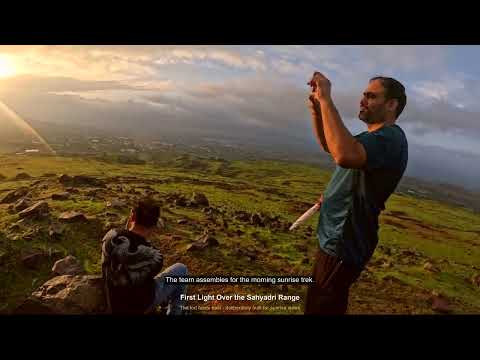
So at 5:15 AM, I was awake — groggy, fumbling for my phone torch, layering up against the cool pre-dawn air that rolls down from the Sahyadri hills. By 5:45, we were moving through the fort grounds in near-total darkness, the only sound being our footsteps on century-old stone pathways. There's something about approaching a 300-year-old fortification in the dark that has no equivalent — not even sprinting onto a volleyball court for a late-evening match under floodlights comes close.
The resort sits within the fort complex itself, which means you're already inside the outermost wall when you wake up. The trek to the upper ramparts and the main bastion isn't particularly long — maybe 20 to 25 minutes of steady walking — but the terrain is uneven, the stone is original, and in low light you want to move carefully. We reached the upper level just as the first grey light began to define the silhouette of the Sahyadri range to the east.
The wait that followed — roughly 40 minutes of sitting on the bastion wall watching the sky shift from deep indigo to violet to a warm amber — is the kind of thing you only experience when you choose the discomfort of an early start. No amount of Instagram scrolling replicates it.
Jadhavgadh Fort: What 316 Years of Maratha History Feels Like Underfoot
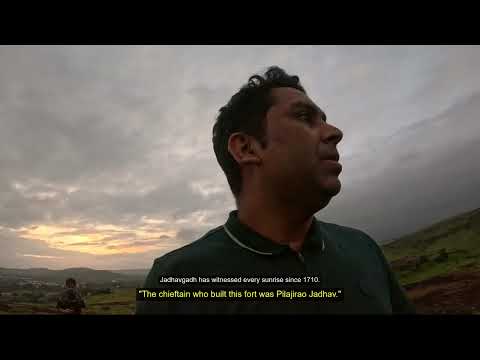
Jadhavgadh Fort was built around 1710 by Pilaji Jadhavrao, a chieftain of the Jadav dynasty — Maratha nobles with deep roots in the Deccan. The Jadavs were a powerful clan in the Pune and Satara districts, and the fort they built at this elevation was both a military strongpoint and a symbol of dynastic authority. At 1,200 metres, it commands views across the entire valley below: the town of Wai, the silver ribbon of the Krishna river, and range after range of Sahyadri ridgelines fading into the distance.
Walking the fort perimeter, what strikes you immediately is the quality of the construction. The outer walls are built from locally quarried basalt — dark, dense, volcanic rock that has barely weathered in three centuries. The mortar joints are still tight. The bastions jut outward at calculated angles to give defenders overlapping fields of fire, a feature you see repeated in every major Maratha fort across Maharashtra, from Raigad to Sinhagad to Pratapgad. These weren't decorative fortifications. They were engineered for war.
The main bastion — which you reach at roughly the 2:50 mark in the video — is the most visually striking structure on the upper fort. It's a multi-tiered tower, probably 10 to 12 metres tall at its highest point, with firing embrasures cut into the walls at multiple levels. Standing inside it and looking out through those narrow slits toward the valley gives you an immediate, visceral sense of what a defender would have seen: an entire approach route laid out below, nothing hidden. The architects understood terrain.
What's unusual about Jadhavgadh compared to many other Maratha forts is that it survived the colonial period largely intact and was eventually restored and converted into a heritage resort. Most Deccan forts are ruins — beautiful ruins, but ruins nonetheless. Here, several structures are still roofed, several interiors are accessible, and the restoration has been done with enough sensitivity that the historical character of the place is preserved. Walking through it doesn't feel like walking through a museum. It feels like walking through a building that was simply very well made.
The Fort Guide Who Made the Bastions Come Alive
We were introduced to the fort guide at around 1:40 into the morning — a local man who clearly knew every stone on the property and narrated the fort's history entirely in Marathi, which for those of us who grew up in Pune is the natural register for talking about the Sahyadris and the Marathas. There is something appropriate about hearing the story of a Maratha fortification in Marathi — it connects the language to the landscape in a way that a translated English tour script never quite manages.
The guide covered the fort in layers. First the architecture — what each structure was for, how it related to the others, how the water supply was managed during a siege. Then the history — the Jadav lineage, the fort's role in the regional political landscape of early 18th-century Maharashtra, the transition from an active military post to a dynastic residence. And finally the practical details that no guidebook captures: where the sentries stood, how the cannon positions were arranged, which direction an attacking force would most likely have approached from.
That last point is answered definitively when you stand on the main bastion and look north toward the valley floor. There is exactly one obvious approach route, and the cannon positions — which the guide explains in detail around the 15:20 mark — cover it completely. The fort's designers had done their threat assessment three centuries before anyone used that phrase.
If you visit Jadhavgadh, ask specifically for the guided morning walk. Don't skip it in favor of exploring on your own. The structures have enough external visual interest to hold you for an hour, but the guide turns a visually interesting walk into an education.
Ancient Cisterns, Cannon Positions, and the Architecture of Maratha Defense
One of the most overlooked features of any Deccan fort is its water infrastructure, and Jadhavgadh is no exception. Around the 4:00 mark in the video, the guide leads us to the ancient cisterns carved directly into the basalt bedrock. These aren't small tanks — they're substantial excavations, deep and wide, designed to collect monsoon rainwater and hold enough for the fort's garrison through a dry siege that could last months.
The engineering logic is simple and brilliant: basalt is impermeable. Cut a cistern into it, plaster the walls lightly to seal any fractures, and you have a storage vessel that requires almost no maintenance and lasts indefinitely. Many of these cisterns at Jadhavgadh are still structurally sound more than 300 years after they were cut. Some still hold water in the monsoon months.
The cannon positions, explained at the 15:20 timestamp, are laid out along the outermost wall at intervals calculated to give maximum coverage of the approaches below. The cannons themselves are long gone — most were removed during the colonial period — but the stone platforms and embrasures remain. The guide points out how the angle of each embrasure was deliberately cut to maximize the horizontal arc of fire while minimizing exposure of the crew inside. This is 18th-century ballistics, solved in stone.
What the video captures well, and what surprised me in person, is how much of this defensive architecture is still readable. You don't need an architectural degree to look at a bastion embrasure and understand what it was for. The Maratha fort builders designed with a clarity that three centuries of weathering haven't eroded.
The Moment the Sun Rises Over the Sahyadri Range
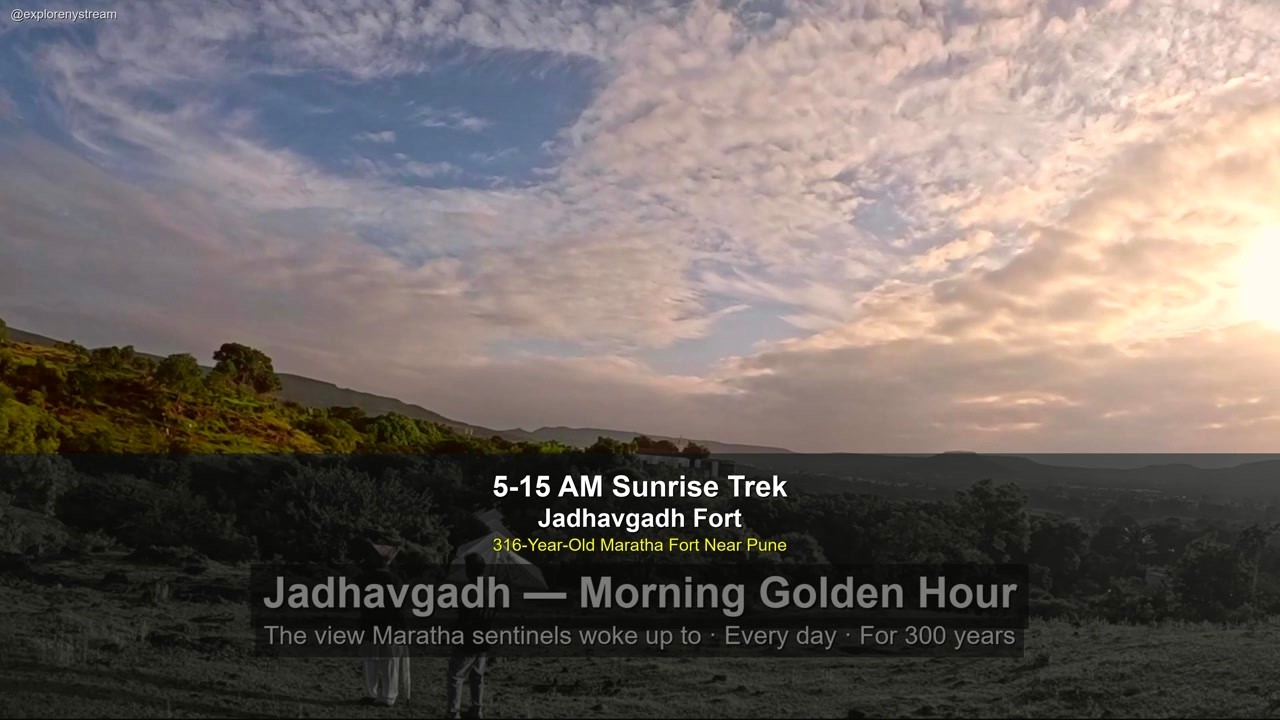
By 6:40 AM we were on the upper bastion wall, facing east over the valley. The sky had moved through its stages — the flat grey of pre-dawn, then a gradual warming at the horizon that turned the distant ridgelines from black silhouettes to textured shapes, ranges within ranges, ridge behind ridge, the whole Sahyadri system revealed in layers as the light increased.
At 6:50 AM, exactly as forecast, the sun broke the horizon.
The moment a Sahyadri sunrise hits a basalt fort wall, the stone changes color. What was grey-black in the pre-dawn becomes warm amber, almost orange. The shadows on the ramparts deepen and lengthen simultaneously as the light rakes across the uneven surface of the stonework. Every projecting course of masonry casts a shadow. Every recess fills with warmth. The fort that was a dark monolithic shape in the dark becomes something richly textured and almost golden.
The valley below fills with light more slowly — the town of Wai, the agricultural patchwork of the floodplain, the line of the Krishna river catching the light like a thread of silver pulled through the landscape. At 1,200 metres you're above the morning haze that sits in the valley bottom, so the view is completely clear. There's no smog, no road noise. Just the sound of wind moving through the Sahyadris and the occasional call of a raptor working the thermals.
I've watched a lot of sunrises. Early-morning volleyball tournaments mean you get used to being awake before the sun. But there's a specific quality to watching daybreak from a 316-year-old fortification that I hadn't experienced before — a sense of witnessing something that thousands of people have witnessed from the same point of earth, across three centuries, under radically different circumstances. The Maratha garrison who watched the sun rise from this bastion in 1720 saw the same ridgeline, the same river, the same light hitting the same stone.
That continuity is the thing Jadhavgadh Fort does to you that no viewpoint bench at a modern hill station can replicate.
Is Jadhavgadh the Best Sunrise Trek Near Pune? Here's My Honest Take
Pune has no shortage of sunrise spots. Sinhagad is the obvious answer — accessible, well-trodden, with real historical weight. Rajgad and Torna give you more dramatic altitude. Shivneri has the birthplace angle. So where does Jadhavgadh sit in that ranking?
Here's my honest assessment:
- Accessibility: Jadhavgadh wins. The resort accommodation means zero logistics — you sleep inside the fort, wake up, and walk uphill. No driving at 4 AM, no parking chaos, no crowds scrambling up a dark trail.
- Historical depth: Comparable to most Sahyadri forts, but the guide is exceptional and the structures are unusually well-preserved. The cisterns and cannon positions are readable in a way that crumbled ruins aren't.
- Sunrise quality: The east-facing upper bastion gives a direct horizon view over the valley without any obstruction. The Krishna river in the foreground, Sahyadri ridgelines behind — the composition is genuinely spectacular.
- Crowds: Near zero. We were essentially alone on the upper fort for the entire sunrise. No selfie queues, no noise. This alone is worth the trip if you've done Sinhagad on a public holiday.
- Cost: The resort stay is not budget backpacker territory — it's a heritage property with corresponding pricing. But the fort trek itself is part of the resort experience, and for what you get, it's worth a once-a-year splurge.
For a weekend warrior who wants history, altitude, a genuine pre-dawn physical effort, and a sunrise that rewards the alarm clock — Jadhavgadh is the most underrated fort trek in the Pune district. Most people who know it know it only as a wedding venue or weekend resort. The sunrise trek dimension is almost entirely undiscovered.
I'll be back. Probably before the next volleyball season wraps up — which for Shreewoods means sometime after the monsoon clears.
Key Takeaways
- Jadhavgadh Fort was built around 1710 by Pilaji Jadhavrao of the Jadav dynasty — one of Maharashtra's best-preserved Maratha-era forts at 1,200 metres elevation near Saswad, Pune district.
- The optimal sunrise window is 6:40–7:00 AM from the upper bastion, with the east-facing wall giving an unobstructed view over the Wai valley and the Krishna river below.
- Book the guided fort walk — the local Marathi-speaking guide transforms the experience from a scenic walk into a forensic reading of 18th-century Maratha military architecture, including cisterns, cannon positions, and bastion design.
- The heritage resort advantage: staying on-site eliminates all 4 AM logistics — you wake up inside the fort, walk uphill, and have the upper ramparts to yourself before any day-trippers arrive.
- Jadhavgadh is Pune's most underrated sunrise trek — better sunrise composition than most Sahyadri viewpoints, near-zero crowds, and a historical setting that makes the early alarm feel worthwhile long after you're home.
Frequently Asked Questions
How far is Jadhavgadh Fort from Pune city?
Jadhavgadh Heritage Fort and Resort is approximately 35–40 kilometres from central Pune, near Saswad in the Pune district. By car or bike it's roughly a 50–60 minute drive depending on traffic, making it one of the most convenient overnight heritage stays within the Pune region.
Is the Jadhavgadh Fort sunrise trek open to non-resort guests?
The fort complex is part of the private heritage resort property. Access to the upper fort and the sunrise trek is primarily available to resort guests. Day visitors may be permitted with prior arrangement through the resort management — it's worth calling ahead if you're not staying overnight.
What time should I start the trek to reach the top before sunrise?
Plan to begin walking by 6:00–6:10 AM for a typical Pune-region sunrise around 6:45–6:55 AM. Starting at 5:45 AM gives you ample time to reach the upper bastion before the horizon begins to glow — you want to be positioned, not still climbing, when the light hits. The walk from the resort to the upper ramparts takes approximately 20–25 minutes on original stonework paths.
Who built Jadhavgadh Fort and how old is it?
Jadhavgadh Fort was built around 1710 by Pilaji Jadhavrao of the Jadav dynasty, Maratha nobles with deep connections to the Deccan. The fort is approximately 316 years old as of 2026, and stands at 1,200 metres elevation in the Sahyadri range of Maharashtra's Western Ghats.
If this got you reaching for your trail shoes, watch the full experience — every step, every stone, the exact moment the Sahyadri sunrise hits the bastion wall — in Sunrise Trek at Jadhavgadh Fort | 316-Year-Old Maratha Fort Near Pune | Sahyadri on @explorenystream. Subscribe so you don't miss the next early-morning adventure — there are more forts in the Sahyadris, and the alarm clock is already set.