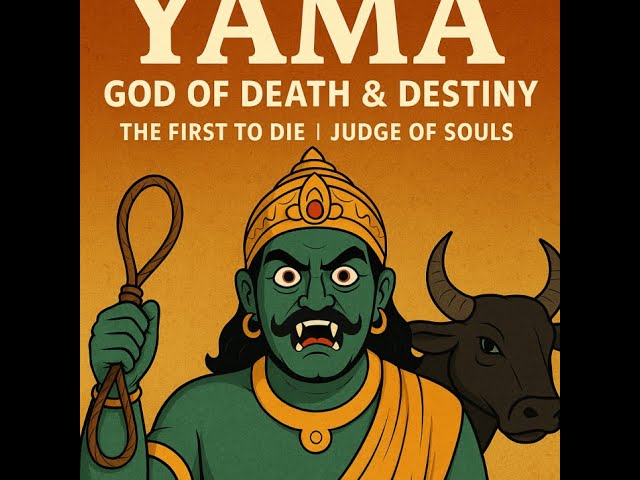
YAMA God of Death & Destiny
September 21, 2026 — ny_wk
🛒 Recommended gear on AmazonDisclosure: some links above are affiliate links — if you buy through them I may earn a small commission at no extra cost to you. Thanks for supporting the channel!
🛒 Today's Picks on Amazon
As an Amazon Associate I earn from qualifying purchases.
As an Amazon Associate I earn from qualifying purchases.
start a profound journey into the heart of Hindu mythology, where the formidable deity Yama, the God of Death, holds dominion over destiny and the cycle of existence. Far more than a simple harbinger of the end, Yama is a complex figure representing justice, cosmic order, and the inevitable truths of life and rebirth.
For those fascinated by ancient wisdom, spiritual travel, and the intricate mix of Asian cultures, understanding Yama is to open up a deeper appreciation for philosophical traditions that have shaped millions. This comprehensive guide delves into Yama's multifaceted role, exploring his origins, iconic representations, and the spiritual significance he holds for devotees and travelers alike across the Indian subcontinent and beyond.
Unveiling Yama: The Supreme Arbiter of Destiny
In the vast pantheon of Hindu deities, Yama is a figure of immense power and profound philosophical importance. Known as the first mortal, he is said to have paved the path to the afterlife, becoming the sovereign of the deceased and the supreme arbiter of their post-mortem journey. His name, derived from the Sanskrit root meaning 'twin' or 'restrainer,' hints at his dual nature: he is both the inevitable end and the guardian of cosmic equilibrium.
Yama's role extends far beyond mere death; he embodies Dharma, the principle of righteous conduct and cosmic law. It is he who meticulously records the actions of every living being, ensuring that souls receive their just desserts, whether in heavenly abodes, purgatorial realms, or subsequent rebirths. This intricate system of karmic justice, overseen by Yama, underscores the Hindu belief in cause and effect and the cyclical nature of existence. Understanding Yama, therefore, is crucial for comprehending the profound spiritual architecture that underpins Hinduism, Buddhism, and Jainism.
The Cosmic Bureaucracy: Yama's Entourage and Realm
Yama doesn't operate in solitude; he presides over a vast celestial bureaucracy. His primary assistant is Chitragupta, the meticulous celestial scribe who maintains an exhaustive record (the Agal Lekha or 'Book of Life') of every human's good and bad deeds. Upon a person's death, their soul is brought before Yama's court, where Chitragupta reads out their life's balance sheet, influencing Yama's judgment.
His mount is a fearsome black buffalo, an iconic symbol that reinforces his powerful and unyielding nature. He is often depicted holding a noose (pasha) to extract the soul from the body and a mace (gada) symbolizing his authority. The realm over which he presides is Yamaloka, the ancestral world, often described as a transit point or a series of complex realms where souls undergo purification or experience the consequences of their actions before reincarnation.
Tales of Yama's interactions with mortals and other deities are plentiful in Hindu scriptures, from the philosophical dialogues in the Katha Upanishad with the young Nachiketa, where Yama imparts profound wisdom about the self and the nature of reality, to his appearances in the Mahabharata and Puranas, demonstrating his unwavering commitment to justice and cosmic order. These narratives serve not only as captivating stories but also as moral and spiritual allegories, teaching devotees about righteousness, the impermanence of life, and the importance of living a virtuous existence.
Yama Across Cultures: From Hindu Lord to Buddhist Protector
The reverence for Yama, the God of Death and Destiny, is not confined solely to Hinduism; his influence profoundly permeates other major Dharmic traditions, particularly Buddhism and Jainism. This cross-cultural presence highlights his fundamental role as a universal archetype representing judgment, consequence, and the cyclical nature of existence.
Yama in Buddhist Traditions
In Buddhism, Yama transforms into Yama Dharmaraja, the King of the Law, or simply Dharmaraja. While retaining his role as the lord of the underworld and judge of the dead, his function becomes intrinsically linked to the Buddhist concept of karma and rebirth. He is often depicted in wrathful forms, particularly in Tibetan Buddhism, where he is a fierce protector of the Dharma and a meditational deity (ishtadevata or yidam).
- Tibetan Buddhism: Here, Yama is crucial to understanding the Bardo Thodol (Tibetan Book of the Dead). He presides over the judgment process, ensuring that beings experience the consequences of their actions in their journey through the bardo (intermediate state) and subsequent rebirths. His fierce imagery serves as a reminder of the impermanence of life and the inevitability of karmic reckoning. Monasteries and temples across the Himalayas, from Ladakh to Bhutan, feature vibrant thangkas and statues of Yama Dharmaraja.
- East Asian Buddhism: In Chinese, Korean, and Japanese Buddhism, Yama is known by various names such as Yanluo Wang (閻羅王), Enma-ō (閻魔王), or Yeomna-daewang (염라대왕). He is often one of the Ten Kings of Hell (or sometimes just one of a few key judges), presiding over distinct realms of purification and consequence. Temples dedicated to these judges, such as the famous Jigoku-dō in Japan, serve as powerful visual aids for devotees contemplating their actions and their karmic implications.
In all these traditions, Yama's role is not to mete out arbitrary punishment but to uphold the cosmic law of karma, guiding sentient beings through the consequences of their deeds and ultimately towards the path of liberation (moksha or nirvana).
Yama in Jainism
Jainism also acknowledges a figure akin to Yama, albeit with a different emphasis. While not a central deity, the concept of a judge of the dead and realms of suffering (naraka) governed by karmic principles aligns with the core understanding of Yama. In Jain cosmology, souls pass through various states of existence determined by their karma, leading to rebirth in different realms, including hellish ones. Though not personified as a single dominant deity, the underlying principle of a cosmic arbiter of consequences for one's actions remains a powerful force in Jain philosophical thought.
Iconography and Symbolism: Recognizing the Lord of the Underworld
The visual representation of Yama is steeped in profound symbolism, each element conveying aspects of his authority, justice, and fearsome power. For those exploring temples, museums, and spiritual sites across Asia, understanding these iconographic cues enhances the appreciation of this pivotal deity.
- Color and Demeanor: Yama is most frequently depicted with a dark complexion, often blue or black, symbolizing his association with death and the unknown. His expression is typically fierce and wrathful, with bulging eyes, a prominent moustache, and often fangs. This fearsome appearance is not meant to inspire fear for its own sake but to underscore the gravity of his role and the inevitability of his judgments.
- Mount: The Black Buffalo: His vahana (mount) is consistently a powerful black buffalo, a creature associated with strength, stubbornness, and sometimes wild, untamed nature. The buffalo serves as a potent symbol of Yama's ability to overcome obstacles and his relentless pursuit of justice. It also links him to agrarian societies where buffaloes were central to life and death.
- Attributes (Weapons and Objects):
- Noose (Pasha): Perhaps his most characteristic attribute, the noose is used to extract the soul (jiva) from the physical body at the time of death. It symbolizes the inescapable grip of time and destiny.
- Mace (Gada): The mace signifies his authority, power, and ability to enforce divine justice. It represents the consequences that await those who stray from Dharma.
- Staff: In some depictions, he holds a staff, sometimes adorned with skulls, further emphasizing his dominion over death and the cycle of life.
- Book/Scroll: In many Buddhist and some Hindu depictions, Chitragupta or Yama himself holds a book or scroll (the Agal Lekha), representing the meticulously kept records of all actions.
- Crown/Headdress: He often wears a crown adorned with skulls or flaming jewels, signifying his sovereignty over the dead and the fiery nature of some of the hellish realms he oversees.
- Surroundings: Yama is frequently portrayed amidst flames, in cremation grounds, or surrounded by his attendants (Yamadoots) and various tormented souls, all vividly illustrating his domain and function.
These elements, whether seen in intricate temple carvings, elaborate thangka paintings, or majestic statues, combine to create a powerful and instantly recognizable image of the God of Death & Destiny, reminding viewers of the universal principles of karma, judgment, and the ultimate impermanence of material existence. Such imagery serves as a potent spiritual reminder for devotees to lead a righteous life, knowing that all actions bear consequences.
Plan Your Visit: Encountering Yama's Influence
For the spiritual traveler or cultural explorer, tracing the presence of Yama across Asia offers a profound journey into faith, philosophy, and art. While explicit "Yama temples" are less common than shrines to other major deities, his presence is woven into the fabric of countless sacred sites.
Where to Seek Out Yama
- India:
- Chitragupta Temples: Though rare, temples specifically dedicated to Chitragupta, Yama's scribe, can be found. The Chitragupta Temple in Kanchipuram, Tamil Nadu, is a notable example, underscoring the importance of record-keeping in the divine judgment.
- Sacred Pilgrim Sites (e.g., Gaya, Varanasi): Major pilgrimage sites like Gaya (Bihar) and Varanasi (Uttar Pradesh) are deeply associated with rituals for the deceased (shraddha and pind daan). While not directly to Yama, these rituals acknowledge his role in guiding ancestors. Statues and depictions of Yama can be found in larger temple complexes.
- Museums and Art Galleries: Major museums across India (e.g., National Museum, Delhi; Indian Museum, Kolkata) often house ancient sculptures and bronzes depicting Yama and his iconography.
- Nepal:
- Pashupatinath Temple, Kathmandu: While primarily dedicated to Shiva, the extensive complex along the Bagmati River is a significant cremation site. The rituals performed here are deeply tied to the cycle of life and death, and Yama's presence is philosophically palpable. You might find smaller shrines or carvings of Yama within larger temple complexes or near cremation ghats.
- Tibetan Buddhist Monasteries: In regions like Mustang or the Kathmandu Valley (e.g., Boudhanath Stupa area), many monasteries feature thangka paintings and statues of Yama Dharmaraja in his wrathful form, especially in protector chapels (gomkhang).
- Tibet (and Tibetan Cultural Regions - Ladakh, Bhutan):
- Monasteries: Virtually every significant Tibetan Buddhist monastery will have vibrant thangkas and elaborate statues of Yama Dharmaraja as a protector deity. Look for dedicated protector chapels (gomkhang) where his imagery is prominent. Sites like Tashilhunpo Monastery (Tibet), Hemis Monastery (Ladakh), or Punakha Dzong (Bhutan) are excellent places to witness this.
- Southeast Asia (e.g., Cambodia, Thailand, Indonesia):
- Angkor Wat, Cambodia: The bas-reliefs of Angkor Wat famously depict the 'Churning of the Ocean of Milk' and scenes from the Hindu epics. Within these, particularly on the south gallery, you'll find extensive and graphic depictions of heaven and hell, with Yama presiding over the judgment of souls in the underworld. It's one of the most vivid visual representations of Yama's court.
- Bali, Indonesia: While Balinese Hinduism has its unique syncretic flavor, the concept of karma and the afterlife overseen by deities akin to Yama is present. Look for depictions in temple art (pura) or during traditional ceremonies.
- East Asia (e.g., China, Japan, Korea):
- Buddhist Temples: Temples often have dedicated halls (e.g., "Hall of the Ten Kings of Hell") where Yama (Yanluo Wang/Enma-ō) and his fellow judges are depicted in vivid, often intimidating, forms. These provide powerful visual instruction on karmic consequences. Examples include Japanese temples with their jigoku-e (hell paintings) or Chinese temples with elaborate underworld dioramas.
Practical Tips for Travelers
- Respect Local Customs: When visiting temples or sacred sites, dress modestly (shoulders and knees covered) and follow local etiquette, such as removing shoes.
- Hire a Local Guide: A knowledgeable local guide can provide invaluable insights into the specific iconography and cultural significance of Yama within the context of the site you are visiting.
- Be Observant: Yama's imagery is not always monumental. Look for smaller carvings, painted murals, or even ritualistic objects that might feature him.
- Photography: Always ask permission before taking photos, especially of people or during ceremonies. Some areas within temples may prohibit photography entirely.
Engaging with the iconography and philosophical underpinnings of Yama, the God of Death & Destiny, offers a unique lens through which to view the rich spiritual traditions of Asia. It's a journey not just through geographical locations but into the deepest questions of life, death, and the meaning of existence itself.
Key Takeaways
- Yama is the formidable Hindu God of Death and Destiny, the first mortal, and the supreme arbiter of cosmic justice and Dharma.
- He presides over Yamaloka, judging souls based on their karma, aided by his celestial scribe, Chitragupta.
- Yama's iconography includes a dark complexion, wrathful expression, riding a black buffalo, and holding a noose and mace, symbolizing his power and inescapable authority.
- His influence extends beyond Hinduism, with significant roles as Yama Dharmaraja in Buddhism (especially Tibetan) and Yanluo Wang/Enma-ō in East Asian Buddhism, upholding karmic law.
- Travelers can encounter Yama's presence in temples and sacred sites across India, Nepal, Tibet, Southeast Asia (notably Angkor Wat), and East Asia, often depicted in vivid artistic representations of the afterlife and judgment.
Frequently Asked Questions
What is Yama's main role in Hinduism?
Yama's main role in Hinduism is to serve as the God of Death and Destiny. He is the divine judge who presides over the afterlife, determining the fate of souls based on their karma (actions during life), ensuring cosmic balance and upholding Dharma (righteousness). He is not seen as evil, but rather as an impartial enforcer of universal law.
How does Yama relate to Karma?
Yama is intrinsically linked to the concept of karma. He is the cosmic administrator who ensures that every soul experiences the consequences of its actions, both good and bad. His scribe, Chitragupta, meticulously records all deeds, and Yama uses this record to determine whether a soul ascends to heavenly realms, undergoes purification in lower realms, or is reborn in a particular form, thereby upholding the principle of karmic justice.
Is Yama worshiped?
While Yama is a powerful and respected deity, direct worship in the form of dedicated temples or daily rituals is less common compared to other major gods like Vishnu, Shiva, or Devi. Instead, his role is acknowledged and honored during specific death-related rituals (like shraddha ceremonies for ancestors), and his presence serves as a philosophical reminder of mortality and the importance of living a virtuous life in Hindu and Buddhist traditions.
Where can I see depictions of Yama?
You can see vibrant depictions of Yama across various regions influenced by Dharmic religions. Notable places include the bas-reliefs of Angkor Wat in Cambodia, numerous Buddhist monasteries in the Himalayas (Ladakh, Bhutan, Nepal) where he appears as Yama Dharmaraja, and in the "Halls of the Ten Kings of Hell" within Buddhist temples in China, Japan, and Korea. In India, he is often found within larger temple complexes or in museums showcasing ancient Hindu art.
To truly grasp the visual power and narrative depth of Yama's domain, we highly recommend watching the captivating exploration by @explorenystream. Their video offers a unique lens into the profound stories and vibrant imagery surrounding the God of Death & Destiny. Don't miss out on this enlightening journey – watch the video now and subscribe to @explorenystream for more incredible insights into cultural and spiritual wonders!