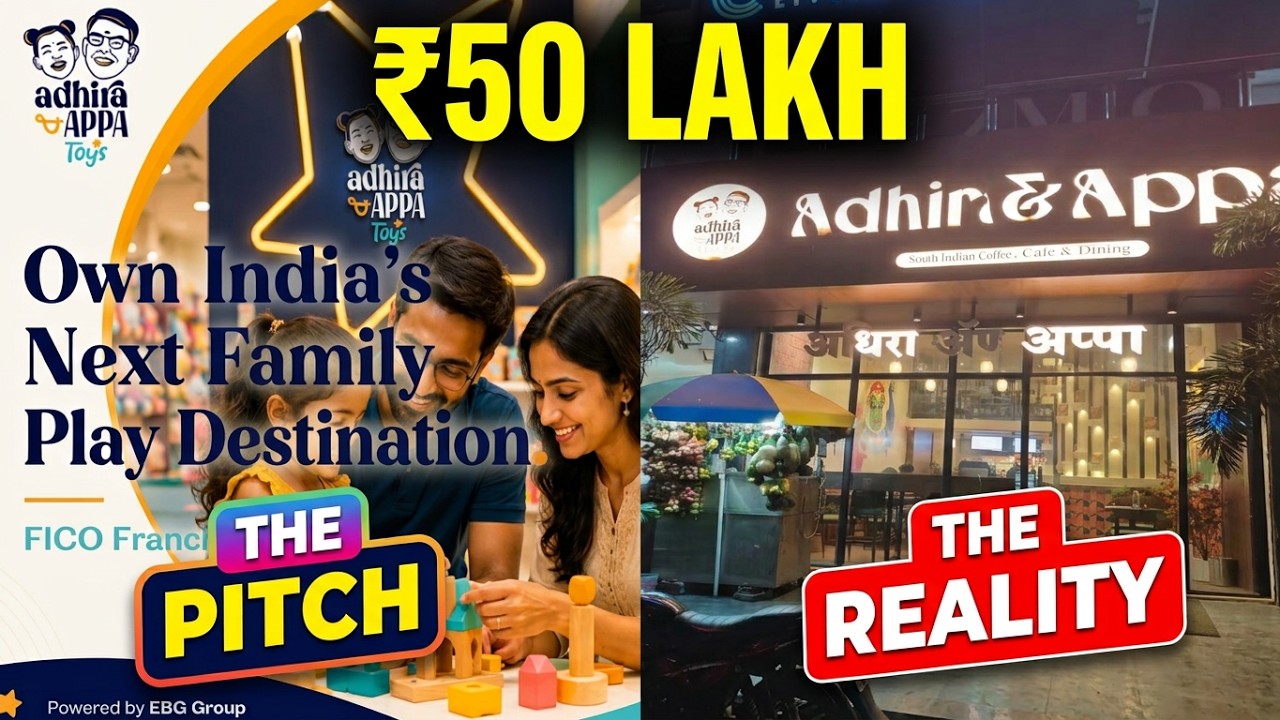
50 Lakh Toy Store Franchise — I Visited the Location Before Investing | Honest Review
October 12, 2026 — ny_wk
🛒 Buy / Check PriceDisclosure: some links above are affiliate links — if you buy through them I may earn a small commission at no extra cost to you. Thanks for supporting the channel!
As an Amazon Associate I earn from qualifying purchases.
50 Lakh Toy Store Franchise — I Visited the Location Before Investing | Honest Review
Before handing over 50 lakh rupees to EBG Group's Adhira & Appa Toys franchise, I did something most investors skip entirely — I physically visited their Viman Nagar, Pune location myself, and what I found completely changed my perspective on this deal. If you are seriously considering the Adhira & Appa FICO franchise opportunity, this honest, on-the-ground review will give you every critical fact you need before signing anything.
Let me set the scene. I am an IT professional based in Pune. I play volleyball on weekends, I coach juniors on Sunday mornings, and when I am not on the court I am the kind of person who absolutely cannot make a financial decision without running it through every angle possible. The same intensity I bring to reading a game — watching the setter, anticipating the block, calculating where the ball is going — I bring to reading an investment pitch. So when EBG Group's sales team invited me to a Google Meet in October 2026 and opened with what sounded like the most frictionless passive income pitch I had heard in years, I did not just nod along. I did my homework. And then some.
What Is the Adhira & Appa Toys Franchise and Who Is EBG Group?
Adhira & Appa is a children's toy retail brand positioning itself as India's premium, emotionally driven family play destination. The concept, at face value, is genuinely well thought out. The store design is built around experiential retail — zones curated around discovery, learning, gifting, and family engagement. Think eight product categories, 300-plus SKUs, spanning everything from infant sensory toys to STEM robotics kits to licensed collectibles. The target age range is zero to twelve years, which conveniently covers almost every parent's shopping window for the better part of a decade.
Behind the brand is EBG Group — Empowering a Better Globe — a Hyderabad-based business house that started its life in electric vehicle logistics. Over time it claims to have expanded into more than twenty brands across multiple sectors. That is an ambitious growth trajectory for any company, and it is worth holding that number in the back of your mind as you read further.
Now here is the detail that stopped me cold before the pitch meeting even officially began. The EBG representative's own materials referenced Adhira & Appa branded locations. So before attending the live investor session, I went and found one. Viman Nagar, Pune. I walked in myself. I took photographs.
What I found was not a toy store.
What I found was Adhira & Appa Coffee — a South Indian coffee café and dining establishment. A completely different brand, a completely different business model, serving filter coffee and meals, not building blocks and robotic kits. I spoke to the people working inside. There is no toy store at that location. There never has been.
When I raised this directly in the investor meeting, the EBG representative confirmed it. Yes, the café is there. Yes, a toy store at that Viman Nagar location would take seven to eight months because the current lease lock-in does not end until February. They then pivoted and proposed a different location — Vasantam City Center in Dhanori — as the alternative site for a toy store.
This pivot matters enormously. Because when a company's own pitch materials reference Adhira & Appa branded locations and the only physical locations that actually exist are coffee cafés, what you are looking at is a pre-launch brand asking for real, post-launch money. As of the time of this review, Adhira & Appa Toys has zero operational toy stores anywhere in India.
The FICO Model Explained — What You Are Actually Buying Into
FICO is the term EBG Group uses throughout their pitch materials, and it needs plain English translation because the structure is fundamentally different from a traditional franchise and carries a very different risk profile.
FICO stands for Franchisee-Invested, Company-Operated.
In a traditional franchise — think a food chain or a retail outlet — you put up the capital and you run the business. You hire the staff, you manage daily operations, you make decisions on the floor. In the FICO model, your role ends at writing the cheque. Here is how the six-step process was presented to potential investors:
- Step 1: You invest the capital — ₹50 lakh, ₹75 lakh, or ₹1 crore depending on the format.
- Step 2: EBG Group uses that capital to build the store — location fit-out, interiors, shelving, branding, point-of-sale systems.
- Step 3: EBG sources all 1,300-plus products from their supplier network.
- Step 4: EBG hires and manages all staff — store managers, floor associates, cashiers.
- Step 5: EBG handles marketing, daily operations, and monthly financial reporting to you as the investor.
- Step 6: Every month, you receive a share of the revenue.
On paper, that sounds like a genuinely passive investment. No operational headaches, no managing leave applications, no dealing with angry customers. Just capital in, monthly returns out.
But here is what the presentation does not say out loud, and what every serious investor absolutely must understand: in a FICO model, you surrender all operational control. You cannot force better sales performance. You cannot fire an underperforming store manager. You cannot renegotiate a bad lease. You cannot redirect marketing spend. If the company decides to quietly prioritise a different investor's location, or if operational decisions go south, your only lever is the contract. Your job, in the company's own framing, is to wait for the cheque.
This structure can work beautifully — but only when the operating company is proven, financially stable, and has a track record of honouring these commitments. The FICO model demands that you trust the operator almost completely. That trust needs to be earned, not assumed.
One more thing that came out during the meeting that is not in the official presentation: EBG Group is simultaneously pitching two completely different FICO franchise categories — Adhira & Appa Toys and Adhira & Appa Coffee — both under the same brand umbrella, both to the same pool of investors, both under an entity that at the time was approximately ten months old. During the meeting the representative actually recommended that for my specific profile, toys would be the better choice. I appreciated the candour. But the fact that a ten-month-old entity is building out multi-category FICO franchises simultaneously across toys and F&B is something every investor should weigh carefully.
Breaking Down the Three Investment Formats and the Financial Math
Adhira & Appa Toys offers three investment formats, each with its own capital requirement and projected monthly revenue:
- Select Format: ₹50 lakh investment. Compact store. Projected monthly sales of ₹20 lakh.
- Prime Format: ₹75 lakh investment. Larger premium store. Projected monthly sales of ₹30 lakh.
- Flagship Format: ₹1 crore investment. Destination format store. Projected monthly sales of ₹40 lakh.
These numbers look attractive on paper. But before you get excited about those monthly revenue figures, anchor yourself to one critical fact: these are projections, not performance data. They are the company's internal assumptions. They are not based on actual store performance because — as established — no Adhira & Appa toy stores have opened yet. There is no historical sales data. There is no comparable store performance to benchmark against. These numbers come from the company's own modelling, built on assumptions about footfall, average transaction values, and product mix in stores that do not yet exist.
Now let us look at the payback period math, because this is where the conversation gets very real very fast.
The pitch presents a 16-month payback period as the headline return scenario. That is an extraordinarily fast return on a ₹50 lakh investment. To achieve it, the store would need to hit its projected revenue targets consistently from month one, and the investor's revenue share would need to be structured at a level that returns capital within that window. This is the optimistic scenario — the one the sales team leads with.
Run the conservative math — accounting for ramp-up time as the store builds its customer base, marketing costs, staff turnover, slow seasonal months, potential location challenges — and the payback period stretches considerably. A 50-month payback scenario is not pessimistic; it is realistic for a new retail brand entering a competitive market without operational history. The difference between 16 months and 50 months is not a minor footnote. It is the difference between a strong investment and a very long wait to simply recover your principal.
The toy retail market in India is real and genuinely growing. Urban middle-class spending on children's experiences and premium educational toys has increased significantly. The experiential retail concept Adhira & Appa is building around is directionally correct — global brands have proven that parents will pay premium prices for curated, experience-first toy retail environments. The market opportunity is not in question. The execution risk — from a brand with no open stores and a ten-month-old parent company — is.
15 Questions Every Investor Must Ask Before Signing a FICO Franchise Agreement
After going through the 20-page investor presentation line by line, attending the live pitch, pushing hard on the numbers, and doing independent research on EBG Group, I put together a list of non-negotiable questions. If you are seriously considering any FICO franchise opportunity — not just this one — get written, documented answers to every single one of these before your pen touches a contract.
- What is the company's incorporation date and legal registration number? Verify it independently on the Ministry of Corporate Affairs portal. For EBG Group, verify when the entity operating these franchises was actually incorporated.
- How many FICO locations under this brand are currently operational? Not under construction. Not planned. Operational, trading, generating revenue today.
- Can you provide audited financial statements for the operating company for the last two to three years? Not projections. Audited accounts.
- What is the exact legal structure of the investor agreement — is it a lease, a loan, an equity stake, or a revenue share contract?
- What happens to your capital if the company winds up, relocates, or rebrands? What is your contractual recourse?
- Who holds the lease on the store premises? If the lease is in the company's name and they default, what protects your investment?
- Are the monthly revenue projections based on actual comparable store data? If yes, which stores and can you visit them?
- What is the minimum guaranteed return, if any? Is there a floor or is it purely revenue-share?
- What is the exit mechanism? If you want your money back after 24 months, how do you get out and under what conditions?
- Who manages the day-to-day cash — is investor money held in an escrow account or commingled with operational funds?
- Can you speak directly to existing FICO investors in this brand, without the company facilitating the introduction?
- What are the reporting obligations — how often, in what format, and is there third-party audit verification?
- Is the franchise agreement registered? Has it been reviewed by an independent franchise lawyer?
- What happens if the company misses the agreed store launch timeline? Is there a penalty or compensation mechanism?
- Has EBG Group or any related entity faced regulatory complaints, investor disputes, or legal proceedings? Search independently — do not rely on company statements.
I want to be clear: asking these questions is not hostile. It is what professional investors do as standard practice. Any legitimate company with a robust franchise operation will have clear, documented answers to every one of them and will not pressure you to sign before you have those answers.
My Honest Verdict After All of This Research
Let me be direct, the way I would be with a teammate who was about to make a risky serve in a deciding set. I would not sugarcoat it.
The concept is genuinely interesting. Experiential toy retail in India is a real opportunity. The market is growing. Urban parents are spending more on quality play experiences. The Adhira & Appa brand aesthetic, based on the pitch materials, is polished and well-positioned. If EBG Group executes cleanly, this could be a meaningful retail brand five years from now.
But the risk profile of investing today is high — and here is why.
You are being asked to invest ₹50 lakh or more in a toy retail brand that has zero operational toy stores. The parent company is approximately ten months old. The location shown to prospective investors in Viman Nagar, Pune is a coffee café, not a toy store. The financial projections are unverified assumptions, not performance data. You will have zero operational control over how your money is used once the cheque is written. And the company is simultaneously building out multiple brand verticals under the same FICO model at the same time.
None of this makes EBG Group fraudulent. To be absolutely clear — I am not making that claim. What I am saying is that this is an early-stage, pre-revenue, pre-store franchise proposition dressed in the language of passive income and proven returns. The gap between the pitch and the current reality is significant. Sophisticated investors — the kind who read 20-page presentations line by line before the meeting starts — need to price that gap into their risk assessment.
If you are still interested after this review, the path forward is simple: wait. Ask for operational store data once stores are open. Visit those stores yourself, unannounced, the way I visited Viman Nagar. Speak to other investors independently. Get the contract reviewed by a franchise lawyer before signing. Give this brand twelve to eighteen months to demonstrate actual operational performance, and then re-evaluate with real data on the table.
Fifty lakh rupees is not a small number for most people. It is years of savings, decades of compounding, real financial security. Treat it like that.
Key Takeaways
- The Viman Nagar location pitched to investors is a coffee café, not a toy store — Adhira & Appa Toys currently has zero operational retail toy stores in India.
- The FICO model means you surrender all operational control — you cannot influence performance, staffing, or lease decisions once capital is deployed.
- Revenue projections of ₹20–40 lakh per month are unverified assumptions, not historical store performance data; the difference between a 16-month and 50-month payback period is enormous.
- EBG Group is simultaneously marketing