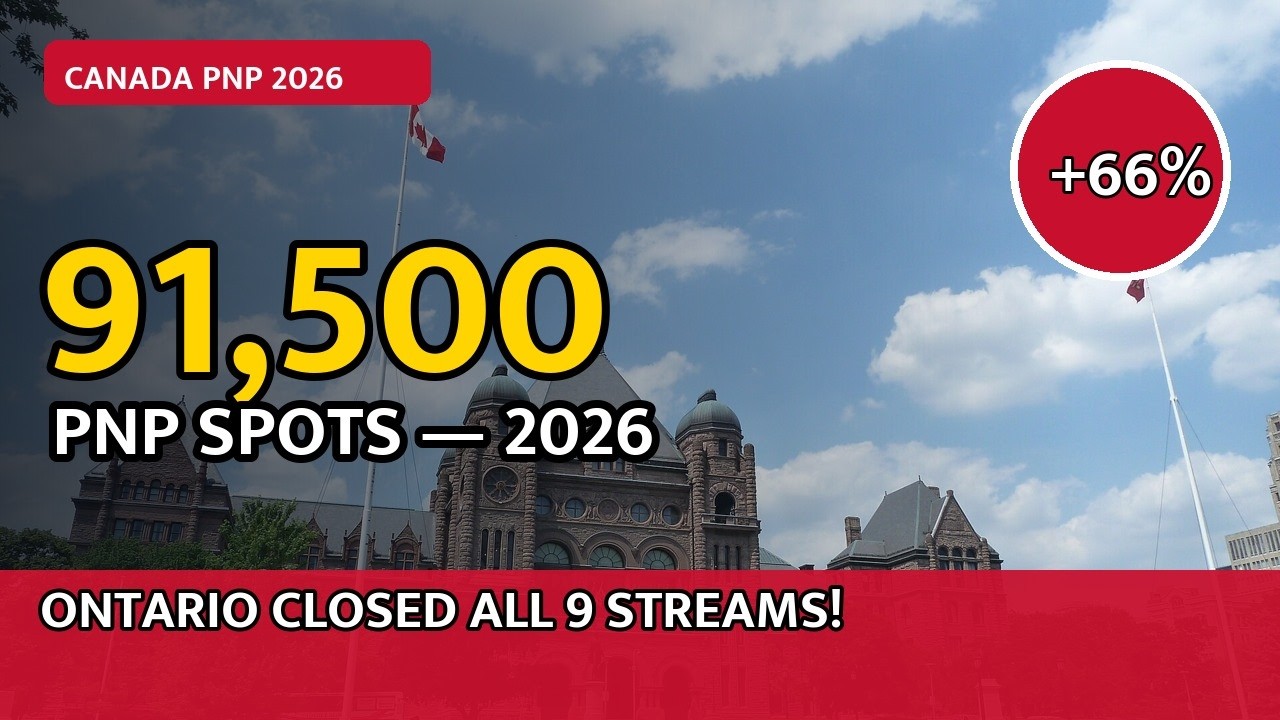
91,500 PNP Spots in 2026! Ontario, BC, Alberta, Saskatchewan — FULL Canada PR Update
July 04, 2026 — ny_wk
🛒 Recommended gear on AmazonDisclosure: some links above are affiliate links — if you buy through them I may earn a small commission at no extra cost to you. Thanks for supporting the channel!
As an Amazon Associate I earn from qualifying purchases.
Canada's Provincial Nominee Program just expanded to 91,500 spots in 2026 — the largest single-year jump in its entire history — and if you know which provinces to target right now, your path to Canadian permanent residence could be shorter than you think.
Whether your Express Entry CRS score is stuck in the 300s or you simply want a faster, more predictable route to Canadian PR, the Provincial Nominee Program (PNP) in 2026 is no longer the backup plan. It is the plan. This comprehensive update covers every major development you need to know: Ontario's dramatic overnight overhaul, the record-breaking national expansion to 91,500 nominations, and exactly which provinces offer the best odds for your specific profile right now.
Ontario's Overnight Reset: All Nine OINP Streams Gone at Once
Let's start with the news that shook the Canadian immigration community to its core. On May 30th, 2026, Ontario repealed every single one of its nine Provincial Nominee Program streams in one sweeping regulatory move. If you blinked, you missed the old Ontario Immigrant Nominee Program as it existed.
The nine streams that were eliminated overnight included:
- Foreign Worker stream
- International Student stream
- In-Demand Skills stream
- Human Capital Priorities stream
- Skilled Trades stream
- Master's Graduate stream
- PhD Graduate stream
- Entrepreneur stream
- Regional Immigration Pilot
This is, without question, the single largest structural change to the OINP since the program began. It wasn't a pause, a temporary closure, or a quiet retooling — it was a full regulatory repeal. And it happened fast.
The New Ontario Workforce Priority Stream: Phase One Is Live
On June 26th, 2026, Ontario launched Phase One of its redesigned program. One unified stream — the Ontario Workforce Priority Stream — now replaces all nine of its predecessors. But don't let the simplicity fool you. Inside this single stream are three distinct pathways, each targeting a very different type of candidate.
- Pathway 1 — Skilled Workers: Designed for candidates employed in TEER 0 to 3 occupations — think managers, engineers, IT professionals, and registered nurses. These are the mid-to-senior level roles Ontario's economy depends on most.
- Pathway 2 — Essential Workers: Open to workers in TEER 4 and 5 roles, covering a broad range of frontline and labour-intensive positions that keep Ontario's industries running.
- Pathway 3 — Self-Employed Physicians: A highly targeted pathway for doctors who intend to be self-employed in Ontario, addressing one of the province's most acute healthcare workforce shortages.
The Critical Catch: It Is Entirely Employer-Driven
Here is the detail that changes everything for thousands of hopeful applicants: the Ontario Workforce Priority Stream is 100% employer-driven. Your employer must be registered with the OINP and must submit an eligible job offer on your behalf before you can even begin an application. There is no self-initiated route, no expression of interest system to enter from abroad, and no workaround.
If you do not have an Ontario employer willing to sponsor you through this process, this stream is simply not available to you — at least not yet. The old Expression of Interest system is permanently closed. No new profiles can be submitted, and outstanding invitations under the old system are no longer being issued.
One important protection does exist: if you submitted a complete application before May 30th, 2026, Ontario has committed to assessing it under the old rules. So if you were already in the pipeline, you haven't necessarily lost your place.
What Phase Two Could Bring — and Why It Matters for International Candidates
Phase One is explicitly described as the beginning of a multi-phase rollout. Phase Two is expected to introduce a healthcare-specific stream, a revived entrepreneur stream, and — perhaps most exciting of all — an exceptional talent stream that may not require a job offer. For skilled workers applying from outside Canada, that last element could be transformational. The new portal is expected to reopen for registration later in summer 2026, so activity could resume any week.
Ontario's 2026 nomination allocation remains robust at over 14,000 nominations. The province isn't retreating — it's retargeting with surgical precision toward the exact labour gaps it most needs to fill.
91,500 PNP Spots in 2026: Understanding the Biggest Expansion in Canadian Immigration History
While Ontario's restructuring dominated the headlines, the bigger strategic picture is even more significant. Under Canada's 2026 to 2028 Immigration Levels Plan, the national PNP target has jumped to 91,500 provincial nomination spots — up from approximately 55,000 in 2025. That is a 66% increase in a single year, and it is the largest one-year PNP expansion ever recorded.
To put that in real terms: in 2025, roughly 55,000 people could receive a provincial nomination across all of Canada's provinces and territories. In 2026, that number is nearly 91,500. The math is straightforward — dramatically more nominations mean more draws, broader eligible occupation lists, and in many streams, significantly lower cutoff scores.
Why This Changes Everything for Lower CRS Score Holders
If your Comprehensive Ranking System (CRS) score sits in the 300s or low 400s, you've likely watched federal Express Entry draw cutoffs remain frustratingly high, sometimes reaching the 480s or 490s for general draws. At those scores, receiving an Invitation to Apply through the federal system alone can feel almost impossible without a specific trade or occupation draw.
Here's the big deal: a provincial nomination automatically adds 600 CRS points to your Express Entry profile. That's not a small boost — it's a near-guarantee of receiving an ITA in the very next Express Entry draw after your nomination is confirmed. This is precisely why the PNP pathway deserves your full strategic attention in 2026. With 91,500 spots available nationally, the probability of securing a nomination — if you apply to the right province for your profile — has genuinely never been higher.
The PNP is not a consolation prize for people who can't crack Express Entry. In 2026, it is the fastest, most reliable route to Canadian PR for the majority of skilled immigration candidates.
Western Canada Deep Dive: BC, Alberta, and Saskatchewan in 2026
The western provinces offer three very different PNP environments in 2026, each with distinct priorities, allocation sizes, and competitive dynamics. Understanding which one aligns with your background could save you months of waiting.
British Columbia: Care, Build, Innovate
BC's provincial nominee program has crystallized around three clearly defined priority sectors it calls Care, Build, and Innovate — representing healthcare, infrastructure, and technology innovation talent respectively. The province is being intentional about whom it wants to attract and why.
The standout opportunity right now is BC's Temporary Rural Health Initiative, running approximately 250 nominations targeting healthcare workers willing to relocate to rural and smaller communities across the province. If you're a nurse, physician, allied health professional, or healthcare technician with adaptability, this is arguably one of the most accessible nomination pathways in the entire country at this moment. Rural communities in BC are chronically underserved, and the province is motivated to fill those roles quickly.
Beyond rural health, BC's tech and innovation streams continue to attract high-skilled candidates, and the province's Express Entry-aligned streams remain active for candidates with strong federal profiles.
Alberta: Big Allocation, Competitive Pools
Alberta's Alberta Advantage Immigration Program (AAIP) carries a 2026 allocation of approximately 6,400 nominations with an application fee of $840. On paper, those numbers look promising. But the reality beneath them requires honest assessment.
Some of Alberta's pools are dramatically oversubscribed. The tourism and hospitality stream, for example, currently has nearly 5,000 candidate profiles competing for roughly 150 available spots. If your background is in that sector, your odds in Alberta's program are extremely challenging under current conditions.
However, Alberta's Express Entry-aligned streams and job-offer-supported streams — particularly for technology workers, engineers, and skilled trades professionals — remain genuinely competitive and worth pursuing if your occupation and profile align with those priorities. The key is choosing your stream carefully rather than applying broadly and hoping.
Saskatchewan: New Intake Windows Create Strategic Timing Opportunities
Saskatchewan made a significant structural change to its provincial nominee program in 2026 that every applicant needs to understand. The province has moved away from its previous rolling draw model and transitioned to fixed intake windows — six defined periods per year when applications can be submitted for capped sectors.
Those six windows fall in January, March, May, July, September, and November. Saskatchewan's 2026 allocation sits at approximately 4,700 nominations with a relatively accessible $350 application fee.
The practical implication is significant: timing your application to align with an intake window is now essential. If the July window is currently open or approaching, that represents an immediate and concrete action you can take right now. Missing a window means waiting for the next one — potentially two months away. Candidates who understand the intake calendar have a structural advantage over those who don't.
Atlantic Canada and Manitoba: The Hidden Immigration Opportunity of 2026
If there is one overarching theme in Canada's immigration landscape for 2026 that deserves far more attention than it gets, it is this: Atlantic Canada is actively hunting for immigrants, and the competition for nominations there is dramatically lower than in Ontario, BC, or Alberta.
New Brunswick, Nova Scotia, Prince Edward Island, and Newfoundland and Labrador are all experiencing chronic, persistent labour shortages in three sectors above all others: healthcare, skilled trades, and information technology. These provinces need immigrants not as an abstraction or a policy goal but as an urgent economic necessity — and that desperation translates into genuine opportunity for the right candidates.
Nova Scotia: Streamlined and Fast
Nova Scotia has consolidated its nominee program into four streamlined pathways designed specifically to accelerate processing times. Faster processing means faster nominations, and faster nominations mean faster PR timelines. For candidates who qualify, Nova Scotia's program currently offers one of the most efficient end-to-end pathways to permanent residence available anywhere in Canada.
New Brunswick: Mobility Days and Direct Employer Connections
New Brunswick is running Mobility Days this fall — structured recruitment events that physically bring employers and immigration candidates together in one place. If you can attend one of these events and connect directly with a New Brunswick employer willing to support your nomination, your probability of success improves dramatically. This is one of the few programs in Canada where showing up — literally — can meaningfully change your outcome.
PEI and Newfoundland: Points-Based Systems With Realistic Cutoffs
Both Prince Edward Island and Newfoundland and Labrador operate points-based nomination systems where even moderate scores are currently generating invitations. These are not programs designed to attract only elite candidates with perfect profiles. They are programs designed to attract workers who are genuinely committed to building their lives in communities that need them. If your score would never crack a competitive Ontario or BC draw, these provinces may be where your Canadian story begins.
Manitoba: Active Draws With Real Volume
Manitoba ran a recruitment draw in June 2026 issuing over 120 invitations — a signal that the province is actively processing candidates and not sitting on its allocation. Manitoba's program rewards candidates who demonstrate genuine ties to the province and occupational demand alignment. It often flies under the radar precisely because it lacks the name recognition of Ontario or BC, but for the right profile, it consistently delivers results.
Your PNP Strategy for 2026: How to Choose the Right Province for Your Profile
Understanding the landscape is valuable. Translating it into a concrete personal strategy is what actually gets you nominated. Here is how to think through your approach systematically.
Step 1: Assess Your Occupation and TEER Level First
Every PNP stream in Canada is built around occupation targeting. Before you evaluate a single province, know your National Occupational Classification (NOC) code and your TEER level. TEER 0-2 candidates have the widest range of options. TEER 3-4 candidates may find Atlantic Canada and Saskatchewan more accessible. TEER 5 candidates should focus specifically on streams designed for essential workers.
Step 2: Map Your CRS Score to the Right Strategy
If your CRS score is above 470, you may be competitive in federal Express Entry general draws without needing a provincial nomination — but a PNP nomination still accelerates your timeline dramatically. If your CRS score is below 450, your fastest path to PR almost certainly runs through a provincial nominee program, and that should be the center of your strategy, not a fallback.
Step 3: Match Your Profile to Provincial Priorities
- Healthcare workers: BC's Rural Health Initiative, Nova Scotia, New Brunswick, and Newfoundland are your top three targets right now.
- Tech and IT professionals: BC's Innovate stream, Ontario's Workforce Priority Stream (if you have an employer), and Alberta's tech-aligned streams.
- Skilled trades: Saskatchewan, Alberta, and Atlantic Canada all have acute trades shortages and active streams.
- International graduates: With Ontario's student stream eliminated, explore Nova Scotia, Manitoba, and Saskatchewan as alternatives.
- Candidates without a Canadian job offer: Atlantic Canada points-based streams, Saskatchewan's occupation-driven draws, and Manitoba are your most realistic immediate options.
Step 4: Monitor Intake Windows and Draw Schedules
In 2026, timing is a competitive advantage. Saskatchewan's fixed windows, BC's rolling draws, and New Brunswick's Mobility Days all have specific dates that reward candidates who track them. Bookmark the official provincial immigration pages, set calendar reminders for intake windows, and have your documentation ready before the window opens — not after.
Step 5: Always Consult a Licensed RCIC
Immigration law changes fast, and the stakes of getting it wrong are high. Before submitting any PNP application, consult a Regulated Canadian Immigration Consultant (RCIC) or immigration lawyer who is