
NYC's Industrial Roots: A Self-Guided Tour of Repurposed Factories & Historic Waterfronts
October 17, 2026 — ny_wk

Disclosure: some links above are affiliate links — if you buy through them I may earn a small commission at no extra cost to you. Thanks for supporting the channel!
New York City’s industrial heritage tour reveals the city's manufacturing heart, transformed from gritty factories and busy waterfronts into vibrant cultural hubs and public spaces. This self-guided journey explores iconic repurposed sites and historic districts, showcasing the enduring spirit of innovation that built the metropolis.
I’ve always been drawn to places that wear their history like a badge of honor. There’s a certain magic in walking through old factory districts, imagining the clang and hum of machines, the scent of fresh bread, or the shouts of longshoremen. New York City, for all its gleaming skyscrapers, holds an incredible secret: a vast network of industrial spaces and historic waterfronts that have been lovingly, cleverly, and sometimes dramatically repurposed. This isn't just about pretty parks; it's about seeing the literal foundations of the city we know today, brick by sweat-stained brick. If you're looking for an authentic NYC industrial heritage tour, one that peels back the layers of concrete and glass, then lace up your walking shoes. We’re going deep into the city’s manufacturing past, tracing the lines of innovation and reinvention that truly define New York.
Manhattan's West Side: From Elevated Rails to Green Oases
Our journey begins on Manhattan’s west side, a place that vividly illustrates the city’s ability to transform. For decades, this stretch of the waterfront was a hive of activity, dominated by freight trains delivering goods to factories and warehouses, and ships docking along the Hudson River. Today, much of it is a sign of what thoughtful urban planning can achieve, blending history with contemporary life.
The High Line: A Walk Through Time
My first recommendation for any exploration of NYC industrial heritage is always the High Line. You might know it as a beautiful elevated park, a popular spot for a stroll with incredible city views. But its origins are far grittier, and understanding that context makes a walk along its pathways even more meaningful.
Back in the day, the west side of Manhattan was a dangerous place for pedestrians. Street-level freight trains, often called the "Death Avenue" trains, caused so many accidents that a group of cowboys had to ride ahead waving red flags. To solve this, the elevated West Side Freight Line was built, opening in 1934. It carried goods – meat, dairy, produce – directly into factories and warehouses, bypassing street traffic. Imagine trains rumbling past third-story windows, a lifeline for the city's economy. The last train ran in 1980, carrying three carloads of frozen turkeys.
For years, the structure lay abandoned, an overgrown urban ruin. The plants that reclaimed it naturally are part of the genius of its current design. When you walk the High Line today, pay attention to the details: the original rail lines peeking through the paving, the preserved industrial tracks that serve as planters, the sturdy steel framework that once supported tons of freight. Sections of the park even incorporate design elements that mimic old train track switches or loading docks. The way the park winds through and even *into* buildings, like the old Nabisco factory (now Chelsea Market), truly connects you to its past purpose. It's a prime example of adaptive reuse, turning a piece of infrastructure that once divided neighborhoods into a public space that connects them.
Pro Tip: Visit during a weekday morning to experience it with fewer crowds. Stop at the various lookout points; they often offer information about the buildings below and the history of the rail line. Looking down at the Meatpacking District, you can still spot the historic markets and brick buildings that once buzzed with activity, now home to high-end boutiques and restaurants.
Chelsea Market: A Culinary Hub in a Cookie Factory
Just beneath the High Line, and actually integrated into it, is Chelsea Market. This isn't just a food hall; it’s the former National Biscuit Company (Nabisco) factory complex, where the Oreo cookie was invented in 1912! Think about that for a second – one of the world's most iconic cookies came from right here.
The architecture speaks volumes: heavy brick, large industrial windows, exposed pipes and ductwork inside. When you walk through its bustling corridors, you're literally traversing the same floors where dough was mixed, cookies were baked, and packaging lines whirred. Developers maintained much of the original industrial aesthetic during its transformation, creating a space that feels both historic and vibrantly modern. The open-plan design and high ceilings are remnants of its manufacturing past, now perfect for accommodating diverse food vendors, unique shops, and office spaces.
I always make a point to grab a pastry or coffee here. It’s a delicious way to experience a piece of history. Imagine workers taking their breaks in these very halls, perhaps dreaming of a world where their factory would become a gourmet destination. It’s a powerful illustration of how the demand for new urban experiences can breathe new life into old industrial giants.
Hudson River Park: Where Piers Once Ruled
Beyond the High Line, the vast expanse of Hudson River Park stretches along the waterfront, occupying land that was once a relentless series of active shipping piers and industrial facilities. From the 19th to mid-20th century, these piers were the gateway to America, handling everything from transatlantic liners (the Titanic was supposed to dock at Pier 59) to cargo ships laden with goods from around the world.
While most of the original wooden and concrete piers have been replaced or rebuilt, the memory of their industrial past persists. Many of the park's recreational piers are built on the footprints of their predecessors. You can still spot historical markers explaining what ships docked where, or what goods were loaded and unloaded. Pier 57, for instance, once a passenger ship terminal and later a bus depot, is now a beautiful public park and food hall, its innovative structure incorporating the original concrete "superpier" foundation. Walking along the esplanade, you can appreciate the sheer scale of the operation that once took place here – a critical hub for global trade and immigration.

Brooklyn's Waterfront: Giants Transformed and Gritty Arts
Crossing the East River to Brooklyn reveals an even more dramatic landscape of industrial transformation. Brooklyn's waterfront, with its deep-water access and proximity to Manhattan, became a powerhouse of manufacturing, warehousing, and shipping. Today, these neighborhoods are synonymous with trendy loft apartments, artisan workshops, and innovative businesses, but their industrial ghosts are still very much present.
DUMBO: Warehouses Reimagined
DUMBO, an acronym for "Down Under the Manhattan Bridge Overpass," is probably the most iconic example of Brooklyn’s industrial rebirth. What were once sprawling warehouses for paper, coffee, machinery, and even Brillo pads, are now some of the city's most coveted addresses, art galleries, and tech offices.
When I wander DUMBO's cobblestone streets, especially Washington Street with its famous view of the Manhattan Bridge framing the Empire State Building, I can almost hear the horse-drawn carts and early trucks rumbling by. The colossal brick buildings, many dating back to the late 19th century, with their distinct Romanesque Revival architecture, were built to last and to withstand heavy loads. They housed everything from factories producing textiles and machinery to storage for goods arriving at the nearby Fulton Ferry Landing.
One of the best places to experience this history is at Empire Stores. These magnificent brick warehouses, built in the 1870s, sat derelict for decades, their iron shutters rusted shut. Now, they've been stunningly redeveloped into a mix of retail, restaurants, and office space, with a public rooftop park offering unparalleled views of the bridges and Manhattan skyline. The original brickwork, immense timber beams, and the raw, rugged feel have been carefully preserved, making it an architectural marvel that respects its origins. Brooklyn Bridge Park itself, adjacent to DUMBO, is built on former industrial piers, transforming a post-industrial wasteland into a vibrant recreational space with playgrounds, lawns, and stunning views.
Fun Fact: DUMBO was initially known as Fulton Ferry, but real estate developers coined the less appealing acronym in the 1970s to deter gentrification, an effort that clearly failed in the most spectacular way possible.
Williamsburg & Greenpoint: Sugar, Oil, and Art
Further north along the Brooklyn waterfront, the neighborhoods of Williamsburg and Greenpoint offer a different flavor of industrial heritage. Here, heavy industry, particularly sugar refining and oil processing, dominated for generations.
The colossal structure of the former Domino Sugar Refinery in Williamsburg is an unmissable landmark. For over 150 years, this was the largest sugar refinery in the world, processing millions of pounds of raw sugar daily. The building, with its distinctive brick facade and towering chimney, stood as a symbol of Brooklyn's industrial might. It closed in 2004, leaving behind an imposing shell. Today, the site is undergoing a massive redevelopment, but developers have committed to preserving the iconic structure of the original refinery building, incorporating it into a new mixed-use complex. Seeing that old brick edifice rising above the modern construction is a striking visual reminder of the area's past. You can get great views of it from the new Domino Park, which itself is built on the site of former industrial sheds and includes salvaged gantry cranes as historical artifacts.
Greenpoint, just north of Williamsburg, tells a darker, often forgotten story of Brooklyn's industrial past. This area was home to massive oil refineries (like Standard Oil, later ExxonMobil) and chemical plants, leaving a legacy of pollution that the community is still grappling with. Yet, here too, there's transformation. Areas like Bushwick Inlet Park, once slated for luxury condos, is now a growing waterfront park, slowly reclaiming land that was historically industrial. As you walk along the Greenpoint waterfront, you might see signs or plaques referencing its past as a shipbuilding center or a hub for oil storage. It’s a powerful reminder that not all industrial heritage is pretty, but it’s still critical to understanding the city’s evolution and the ongoing efforts to create a cleaner, greener future.
Bushwick: Breweries and Backstreets
Venture a bit inland to Bushwick, and you'll find a neighborhood that was once the "Beer Capital of America." In the late 19th and early 20th centuries, Bushwick was home to dozens of breweries, including the massive Rheingold Brewery. While most of these have long since closed or been demolished, their impact on the street grid and building stock is still apparent.
Many of Bushwick's residential and commercial buildings were built to support the brewery industry and its workers. Today, the area is famous for its vibrant street art scene (the Bushwick Collective is a must-see) and a proliferation of artist studios, galleries, and independent businesses housed in former factory buildings. Look closely at the architecture: the tall ceilings, large windows, and sturdy construction of many buildings betray their origins as light industrial workshops, textile factories, or storage facilities. It's a grittier, less polished example of industrial reuse, where artists and entrepreneurs have organically repurposed spaces, giving the neighborhood a raw, creative energy. I always recommend exploring the side streets; that's where you find the true gems, the smaller, less obvious transformations that tell a compelling story.
Long Island City: Queens' Industrial Powerhouse
Crossing back over to Queens, Long Island City (LIC) presents yet another fascinating chapter in our NYC industrial heritage tour. For much of its history, LIC was a bustling industrial district, strategically located across from Manhattan with extensive rail and water access. It was a hub for manufacturing, warehousing, and transportation, featuring everything from piano factories to baking companies, power plants, and rail yards.
Gantry Plaza State Park: Railroad Giants on the River
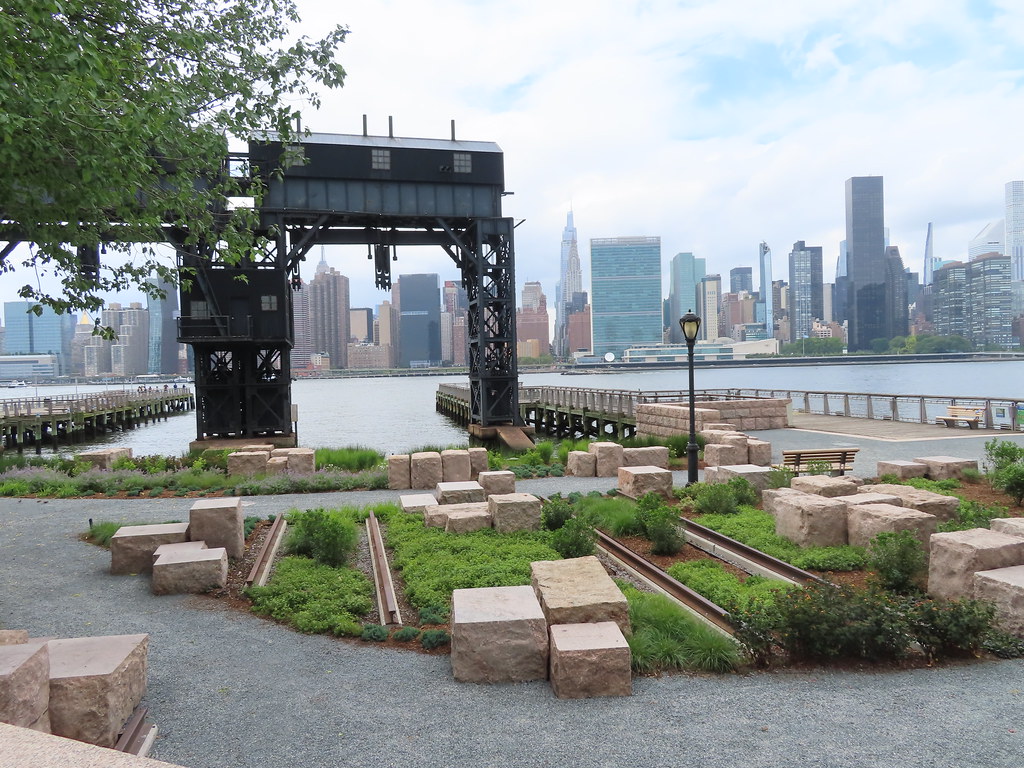
My absolute favorite spot in LIC, and perhaps one of the most visually stunning examples of industrial reuse in the city, is Gantry Plaza State Park. This isn't just a park with a nice view; it's an homage to the massive industrial infrastructure that once dominated this section of the East River.
The park is named for the enormous steel gantry cranes that stand proudly on the waterfront. These aren't decorative sculptures; they are actual remnants of the Long Island Rail Road (LIRR) yard that operated here for decades. These gantries, built in the early 20th century, were used to lift entire freight cars off barges and onto rail lines, moving goods to and from Manhattan and beyond. Can you imagine the sheer power and ingenuity required for such an operation? Standing beneath these towering structures, you get a palpable sense of the scale of early 20th-century commerce.
The park itself has been designed to incorporate other elements of its past, including old rail tracks and a beautifully restored dock. It’s a truly peaceful place to reflect on the city's past while enjoying panoramic views of the Manhattan skyline, including the iconic United Nations building. It’s a prime example of how even the most gargantuan industrial relics can be integrated into public space, becoming monuments to their own history.
Socrates Sculpture Park: From Dump to Art Haven
A little further north along the waterfront in LIC, you'll find Socrates Sculpture Park. This is a story of truly radical transformation. What was once an illegal landfill and abandoned dockland, strewn with garbage and debris, has been transformed by artists and activists into a dynamic outdoor museum and community art space. It started in 1986, when artist Mark di Suvero and a group of local artists began clearing the site. It shows what passion and vision can achieve, even with the most unpromising beginnings.
While not a "repurposed factory" in the traditional sense, the park's very existence is a direct response to, and a reclamation of, an industrial wasteland. Its raw, exposed quality, with views across the East River to Manhattan, still carries echoes of its rough past. The art installations often interact with this industrial backdrop, making it a unique and thought-provoking stop on an industrial heritage tour.
MoMA PS1: Art in an Old School
While not strictly industrial, MoMA PS1 offers another fascinating example of adaptive reuse in LIC, located in a magnificent Romanesque Revival public school building, Public School 1, built in 1892. This imposing structure, with its high ceilings, large windows, and institutional feel, was repurposed in 1976 as one of the oldest and largest non-profit contemporary art institutions in the United States. Its transformation highlights how different types of civic infrastructure can find new life as cultural hubs.
The building's original purpose still shapes the visitor experience. Art is displayed in former classrooms, hallways, and even the boiler room, creating a unique dialogue between the art and the architecture. It's a reminder that the spirit of innovation in NYC extends beyond factories and waterfronts to encompass all types of historic structures.
Planning Your NYC Industrial Heritage Tour: Practical Advice
Embarking on an NYC industrial heritage tour is a rewarding experience, but it requires a bit of planning to make the most of it. These sites are spread across different boroughs, so grouping them geographically makes sense.
Suggested Itineraries & Logistics:
- Manhattan West Side (Half to Full Day): Start at the southern end of the High Line (Gansevoort Street) and walk north, exiting at 30th Street. Explore Chelsea Market afterwards. You can then walk west to Hudson River Park. This is easily done on foot and accessible via multiple subway lines (A/C/E, L, 1/2/3).
- Brooklyn Waterfront (Full Day): Take the subway (F train to York Street, or A/C to High Street) to DUMBO. Explore Brooklyn Bridge Park, Empire Stores, and the DUMBO streets. From there, you can walk or take a short ferry ride up to Williamsburg for Domino Park and the surrounding area. Consider a Citi Bike if you're comfortable with urban cycling, as the waterfront has dedicated paths.
- Long Island City (Half Day): Take the 7, E, or G train to Long Island City. Focus on Gantry Plaza State Park first, then walk or take a bus/short ride to Socrates Sculpture Park. MoMA PS1 is also centrally located.
Best Time to Visit:
Spring and fall offer the most pleasant walking weather. Summer can be hot, especially on the exposed waterfronts, but also lively. Winter can be stark and beautiful, but dress warmly. Weekdays are generally less crowded, particularly on the High Line and at popular markets.
Getting Around:
- Subway: NYC's subway system is your best friend for connecting these sites. Get a MetroCard!
- Walking: Many of the sites are best explored on foot. Comfortable shoes are non-negotiable.
- Citi Bike: Excellent for covering ground along the waterfronts, especially in Brooklyn and LIC.
- NYC Ferry: A fantastic way to connect Brooklyn and Queens waterfronts, offering spectacular views and a sense of the city's maritime past. Check schedules and routes.
What to Wear & Bring:
- Comfortable Shoes: You'll be doing a lot of walking.
- Layers: Especially on the waterfronts, winds can pick up.
- Water Bottle: Stay hydrated.
- Camera: Plenty of photo opportunities, from stunning cityscapes to intricate industrial details.
- Snacks: While there are plenty of food options, having a small snack can be helpful.
Tips for Exploration:
- Look Up & Down: Many clues to a building’s past are in its facade, cornices, or even the pavement.
- Read Plaques: Many parks and buildings have historical markers providing context.
- Embrace the Unexpected: Some of the best discoveries are found by simply wandering off the main path. You might find a small art studio in an old garage or a cafe in a former loading dock.
- Imagine: Try to picture what these places were like during their industrial heyday. It really adds to the experience.
The Enduring Spirit of NYC
The story of NYC's industrial past and its subsequent transformation is more than just a tale of changing architecture; it's a narrative about resilience, innovation, and adaptation. It's about a city that never stops reinventing itself, honoring its origins while constantly evolving. These repurposed factories and historic waterfronts aren't just pretty places to visit; they are living museums, each brick and beam holding a story of the people who built this incredible metropolis.
From the clang of industry to the quiet hum of galleries, from the grit of commerce to the calm of public parks, these spaces remind us that even the most formidable structures can find new purpose. They stand as powerful reminders that every layer of New York City’s history contributes to its vibrant, complex, and utterly unique character. I find it endlessly inspiring to see how a city can continually build upon its own past, creating something new and beautiful without erasing what came before.

Key Takeaways
- NYC's industrial past is deeply ingrained in its urban fabric, evident in repurposed factories and revitalized waterfronts.
- Adaptive reuse is a hallmark of NYC's development, transforming utilitarian structures into vibrant public spaces, cultural institutions, and commercial hubs.
- Iconic sites like The High Line, Chelsea Market, DUMBO's Empire Stores, and Gantry Plaza State Park offer firsthand glimpses into the city's manufacturing and shipping history.
- Exploring these areas reveals the scale of past industrial operations and the ingenuity of urban planners and communities in reimagining them.
- A self-guided tour requires comfortable shoes, a MetroCard, and an open mind to discover the rich narratives woven into the city's industrial heritage.
Frequently Asked Questions
What was the main industry in New York City historically?
Historically, New York City was a diverse industrial powerhouse. Major industries included shipping and maritime trade, manufacturing (especially textiles, garments, and machinery), food processing (like sugar refining and brewing), and printing. Its natural harbor and extensive rail network made it a crucial hub for goods distribution and immigration.
What is adaptive reuse, and how does it relate to NYC's industrial heritage?
Adaptive reuse is the process of repurposing old buildings or sites for a purpose other than what they were originally designed for, while often preserving their historical and architectural character. In NYC, it's central to the story of its industrial heritage, transforming former factories, warehouses, and rail lines (like The High Line, Chelsea Market, and Empire Stores) into parks, markets, museums, and residential spaces, breathing new life into structures that might otherwise have been demolished.
How long does an NYC industrial heritage tour typically take?
The duration of an NYC industrial heritage tour can vary greatly depending on how deeply you want to explore. You could focus on one neighborhood, like DUMBO or the High Line, for a half-day trip. To comprehensively cover sites across Manhattan, Brooklyn, and Queens, you would need at least 2-3 full days, breaking it down into geographically sensible segments for walking and subway travel.
I hope this journey into New York City's industrial heart has inspired you! If you loved tracing the lines of history and transformation, be sure to follow @explorenystream for more authentic adventures and insider tips on exploring the incredible depth of New York.
Related reading
- Lower East Side's Sacred Spaces: A Self-Guided Tour of Historic Synagogues & Jewish Heritage
- NYC's Scenic Waterways: A Self-Guided Tour of Ferry Hopping & Water Taxi Adventures
- NYC's Hidden Gothic Revival Gems: A Self-Guided Tour of Spire, Stone, and Story
- Brutalist Architecture in NYC: A Self-Guided Tour of Concrete Giants & Forgotten Futures
- Brooklyn's Craft Beer Trail: A Self-Guided Brewery & Taproom Tour
- Beyond the Boutiques: A Self-Guided Tour of SoHo's Iconic Cast-Iron Architecture & Hidden Courtyards
- Beyond Fifth Avenue: A Self-Guided Tour of NYC's Gilded Age Mansions & Untold Stories on the Upper East Side
- Greenwich Village's Bohemian Rhapsody: A Self-Guided Literary & Counterculture Walk