
Ravan Dahan 2026 | Dussehra Celebration Pune | Jai Shree Ram!
October 21, 2026 — ny_wk
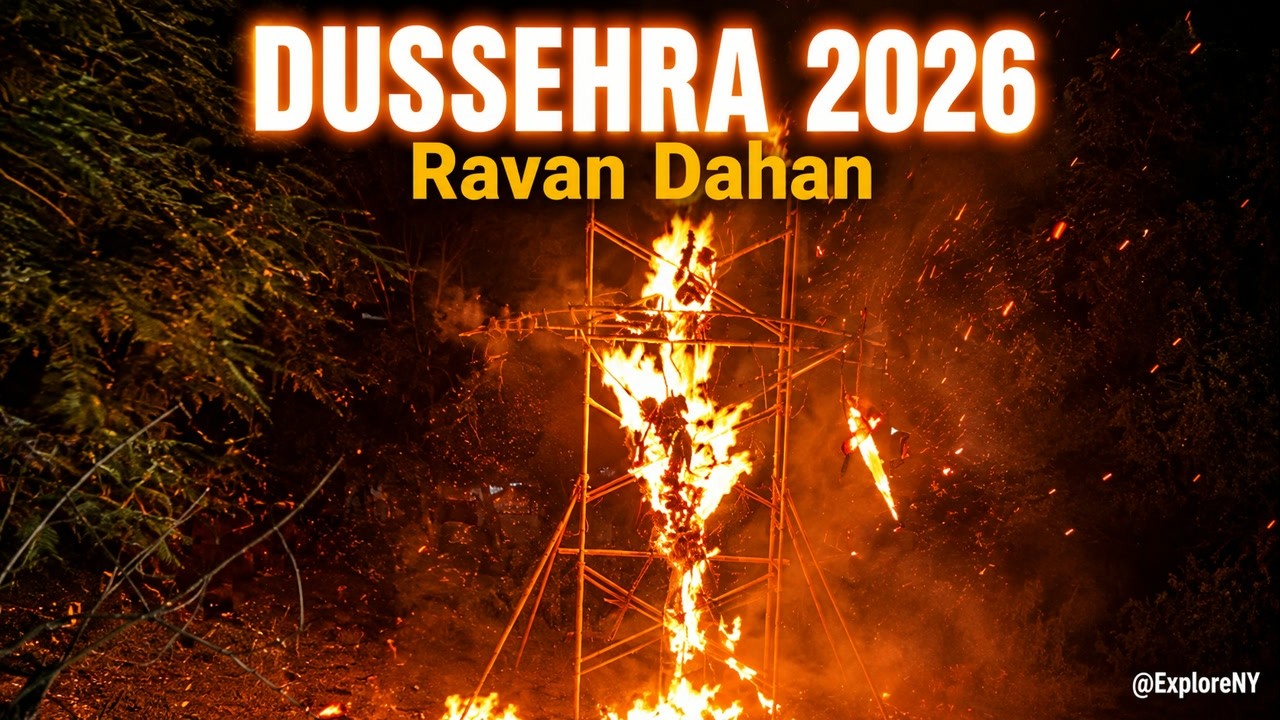
▶ Ravan Dahan 2026 | Dussehra Celebration Pune | Jai Shree Ram! | Subscribe to @explorenystream
Ravan Dahan 2026 | Dussehra Celebration Pune | Jai Shree Ram!
Ravan Dahan 2026 at Shreewoods Society, Pune was nothing short of electric — a full-throated, goosebump-inducing Vijayadashami celebration that reminded every single one of us why Dussehra is the festival that hits differently from any other on the Indian calendar. From the Ram Leela performances to the moment the towering Ravana effigy erupted in flames against the Pune night sky, this was community worship, collective joy, and ancient mythology brought thunderously alive in one modern residential society courtyard.
I've played volleyball every weekend at our society ground for years. I've seen that same patch of earth host birthday parties, cricket tournaments, and lazy Sunday mornings. But every year, when Dussehra rolls around and Shreewoods Society transforms itself for Ravan Dahan, I remember that some traditions are bigger than any sport, any weekend plan, any ordinary evening. This year — 2026 — was the best one yet, and I was lucky enough to watch the whole thing unfold right in front of me.
Why Dussehra and Ravan Dahan Matter So Deeply to Pune
Pune is not just Maharashtra's cultural capital in a textbook sense. It is a city that lives its festivals with an intensity that outsiders find astonishing and residents find completely natural. Ganesh Chaturthi gets all the international headlines, and rightly so. But Dussehra — Vijayadashami — holds a sacred, visceral space in the Pune psyche that goes beyond spectacle.
The festival marks the victory of Lord Ram over the demon king Ravana, the triumph of dharma over adharma, of light over darkness. In a literal sense it is the tenth day (dashami) of the bright fortnight (shukla paksha) of the Hindu month of Ashwin. But in a lived, breathing, emotional sense? It is the night when an entire society — neighbours who nod at each other in the lift, kids who steal each other's shuttlecocks, aunties who debate sabzi prices — all become one single, chanting, Jai Shree Ram-shouting family.
Pune's Dussehra celebrations are spread across hundreds of localities, housing societies, open grounds, and temple complexes. Each one carries its own flavour. Shreewoods Society's Ravan Dahan has, over the years, carved out a reputation for being warm, participatory, and genuinely community-driven rather than a sponsored spectacle. That intimacy is exactly what makes it unforgettable.
The Mythological Weight Behind the Bonfire
When Ravana burns, it is not just wood and straw going up in flames. The tradition traces directly to the Ramayana, one of Hinduism's two great epics, where the fourteen-year exile of Ram, the abduction of Sita, and the eventual Lanka war culminate in Ram slaying Ravana on this exact tithi. Communities across India re-enact the Ram Leela — a dramatic retelling of the Ramayana — in the days leading up to and including Vijayadashami, before the effigy is set ablaze at dusk.
Ravana is a complex figure. He was a scholar, a devotee of Shiva, a gifted ruler — yet his ego and desire led to his destruction. The burning of his effigy is a reminder: even the most learned, most powerful individual falls when arrogance overrides righteousness. For a weekend-warrior volleyball player like me who has lost more than a few sets because of overconfidence, that lesson lands every single year with fresh sting.
Inside the Celebration: What the Shreewoods Society Ravan Dahan 2026 Looked Like
The ExploreNY Stream video captures the entire arc of the evening beautifully, and having been there in spirit through every frame, I can tell you the atmosphere was layered and rich from the very first second.
Ram Leela Performers and the Aarti Ceremony (0:00 – 0:44)
The evening opened with Ram Leela performers dressed in elaborate costumes — Ram, Lakshman, Sita, and Hanuman rendered in vivid colours, the kind of costumes that take hours of patient tailoring and even more patient wearing in the October warmth. The aarti ceremony that followed was the ceremonial heartbeat of the evening: the circular motion of the diya, the chanting, the bell ringing, the smoke of incense threading upward into the darkening sky.
This is the moment that always gets me. Standing on the same ground where I've dived for impossible balls a hundred times, suddenly everything slows down. The mundane becomes sacred. That is the particular genius of how Indian festivals use familiar spaces — they sanctify the ordinary.
The Crowd Gathers Around the Ravana Effigy (0:45 – 1:19)
As dusk deepened, the crowd began moving toward the Ravana effigy — a towering, hand-crafted figure stuffed with firecrackers, painted with fearsome detail, his ten heads each wearing a crown. The energy shifted perceptibly. Conversations dropped. Children climbed onto shoulders. Phones came out. There was that particular collective breath-holding that happens before something enormous and inevitable.
Kids in festival costumes — little Rams with bows, tiny Hanumans with tails, bright dupatta-clad Sitas — wove through adult legs, completely unbothered by the growing heat of anticipation. This is what makes a society-level celebration different from a stadium event: the children are not spectators. They are participants. They belong to this story as much as the myth does.
The Main Event: RAVAN DAHAN! (1:20 – 4:19)
And then — the arrow flies. The effigy catches. The firecrackers inside begin their staccato percussion. Ravan burns.
Watching the Ravana effigy go up in flames is one of those experiences that is genuinely hard to describe to someone who has never witnessed it. The heat you feel on your face from twenty metres away. The crackling that builds from a whisper to a roar. The way fire transforms a static, painted figure into something kinetic, alive, and then — finally — gone. The collective roar of Jai Shree Ram that erupts from hundreds of throats at once is not a performance. It is a release. A year's worth of frustrations, challenges, losses, and longings sent upward in smoke.
The video captures this central chapter with real intimacy — you can see faces lit orange by the flames, children pointing, elders with their hands folded, young couples recording on phones. Every demographic of a Pune residential society, gathered around one burning effigy, unanimous in this single ancient joy.
Crowd Celebration and the After-Glow (4:20 – 8:59)
Once Ravana has fallen, the celebration does not simply stop. It expands. The crowd celebration that follows a successful Ravan Dahan has its own organic choreography. People who have been standing at respectful distance now move closer. Children sprint toward where the embers glow. Sweets come out — whether it is jalebi, modak, or the simple satisfaction of a cold water bottle shared between friends, there is generosity in the air.
Music from the Ram Leela troupe might carry on. Conversations that were paused during the burning resume, now warmer, more animated. The shared experience of watching Ravan fall creates a social adhesive that casual interaction never quite manages. I have had more genuine conversations with neighbours in the twenty minutes after Ravan Dahan than in months of bumping into them at the lift lobby.
Family Moments and the Finale (9:00 onwards)
The video closes with what I consider its most quietly powerful segment — family moments in the aftermath. Grandparents photographed with grandchildren against the smouldering remnants. Young parents lifting toddlers to see the embers. Teenagers in a loose circle, the festival costume half-discarded, laughing about something only they understand. These are the frames that matter ten years from now. Not the flames themselves, but the faces lit by them.
The Cultural Significance of Housing Society Dussehra Celebrations in Pune
Something worth dwelling on: the fact that this celebration happened in a residential housing society rather than a municipal ground or temple complex is itself significant. Pune's housing society culture — the co-operative, the residents' welfare association, the WhatsApp group that actually organises real things — has become one of the city's most powerful engines for keeping festival traditions alive in an urban setting.
When families move from their ancestral villages or older wadas into apartment complexes, they carry their festivals with them. Shreewoods Society's Ravan Dahan is a perfect example of urban tradition-keeping: the logistics are modern (permissions, safety measures, a professional Ram Leela troupe booked months in advance), but the sentiment is entirely ancient.
For children growing up in these societies, this is not a relic of a fading past. It is simply what Dussehra looks like. And that continuity — the fact that a child watching Ravan burn in 2026 is experiencing the same emotional core as a child who watched it in 1026 or 1526 — is one of the most remarkable things about living culture.
Dussehra vs. Other Major Pune Festivals: What Makes It Unique
- Scale of participation: Unlike Ganesh Chaturthi, which can require months of committee-level organisation, a society Ravan Dahan can be pulled together with relatively modest resources — making it accessible to smaller communities.
- Dramatic impact: The literal burning of a large effigy creates a visual and sensory experience unmatched by any other festival moment in the Pune calendar. It is inherently cinematic.
- Narrative richness: The Ram Leela preceding the burning gives the event a storytelling arc — it is not just spectacle but meaning, mythology, and moral framework delivered through performance.
- Cross-generational appeal: Children love the fireworks and costumes; young adults love the communal energy; elders appreciate the devotional depth. Few festivals thread that needle as cleanly.
- Timing: October's cooler evenings in Pune make standing outdoors genuinely pleasant, adding to the festival's sensory warmth in a way that a summer event never could.
What Every First-Time Ravan Dahan Viewer Should Know
If you are watching the ExploreNY Stream video and experiencing Ravan Dahan for the first time — whether you are a Pune resident who has somehow missed this tradition, or a curious viewer from elsewhere in India or the world — here are the layers worth understanding.
The Ten Heads of Ravana
Ravana's effigy always features ten heads, which in the Ramayana tradition represent his extraordinary scholarly mastery of the four Vedas, the six Upanishads, and various branches of knowledge — a reminder that intellect divorced from ethics is ultimately self-destructive. Some interpretations also read the ten heads as ten vices that each of us carries. When Ravan burns, we are symbolically incinerating our own ego, lust, anger, greed, attachment, pride, jealousy, inhumanity, injustice, and cruelty.
That is a remarkably sophisticated piece of symbolism to pack into a bonfire. And it is why scholars, philosophers, and ordinary people alike find Dussehra meaningful on multiple levels simultaneously.
The Role of Firecrackers Inside the Effigy
The crackling, popping, explosive soundtrack of a Ravan Dahan comes from firecrackers packed inside the effigy. These are not decoration. They serve a narrative function: each explosion is the death of one of Ravana's armies, one of his defences, falling. The final collapse of the effigy — when the main structure buckles and falls — is timed symbolically to coincide with Ram's final arrow.
The sequencing of the fire and explosions is something local pyrotechnicians plan carefully, and a well-executed Ravan Dahan where the effigy burns in dramatic, phased stages is a point of legitimate community pride.
What "Jai Shree Ram" Means in This Context
The chant Jai Shree Ram — "Victory to Lord Ram" or "Glory to Lord Ram" — is the devotional exclamation that runs through the entire Dussehra celebration. In this context it is pure worship: an acknowledgment of Ram's victory, an invocation of the divine, and a communal affirmation of values the festival embodies. Hearing hundreds of voices shout it in unison at the moment Ravan ignites is one of those rare experiences where sound itself becomes architecture, building something invisible but entirely real above the crowd.
Why You Should Document Your Society's Ravan Dahan (And Why ExploreNY Did It Right)
One of the things the ExploreNY Stream channel does beautifully with this video is capture the full emotional arc of the evening rather than just the highlight reel. It would be easy to post a thirty-second clip of Ravan burning and call it content. Instead, the video gives us the Ram Leela performers in their full ceremony, the gathering crowd, the children in costume, the complete burn, the aftermath celebration, and finally the quiet family moments at the end.
That structure matters. Because in twenty years, when those children in festival costumes are adults, they will not just want to see the fire. They will want to see themselves — their families, their neighbours, the specific shape of that evening. Documentation is memory-making, and society Ravan Dahan events deserve this treatment.
If your housing society, neighbourhood, or local organisation holds a Ravan Dahan and you have not been documenting it properly, let this video be your inspiration. A steady hand, a decent smartphone, and the willingness to stay from beginning to end are all you really need. The material — the light, the faces, the chanting — will do the rest.
Key Takeaways
- Ravan Dahan 2026 at Shreewoods Society, Pune was a complete, community-driven Dussehra celebration covering Ram Leela performances, aarti, effigy burning, and post-celebration family moments — captured in full by ExploreNY Stream.
- Vijayadashami in Pune's housing societies represents one of the most vital forms of urban tradition-keeping in modern India, making ancient mythology accessible and participatory for every generation.
- The symbolism of Ravan Dahan — ten heads representing ten vices, the effigy's staged burning representing Ram's battle — gives the spectacle philosophical depth that rewards both casual viewers and devoted practitioners