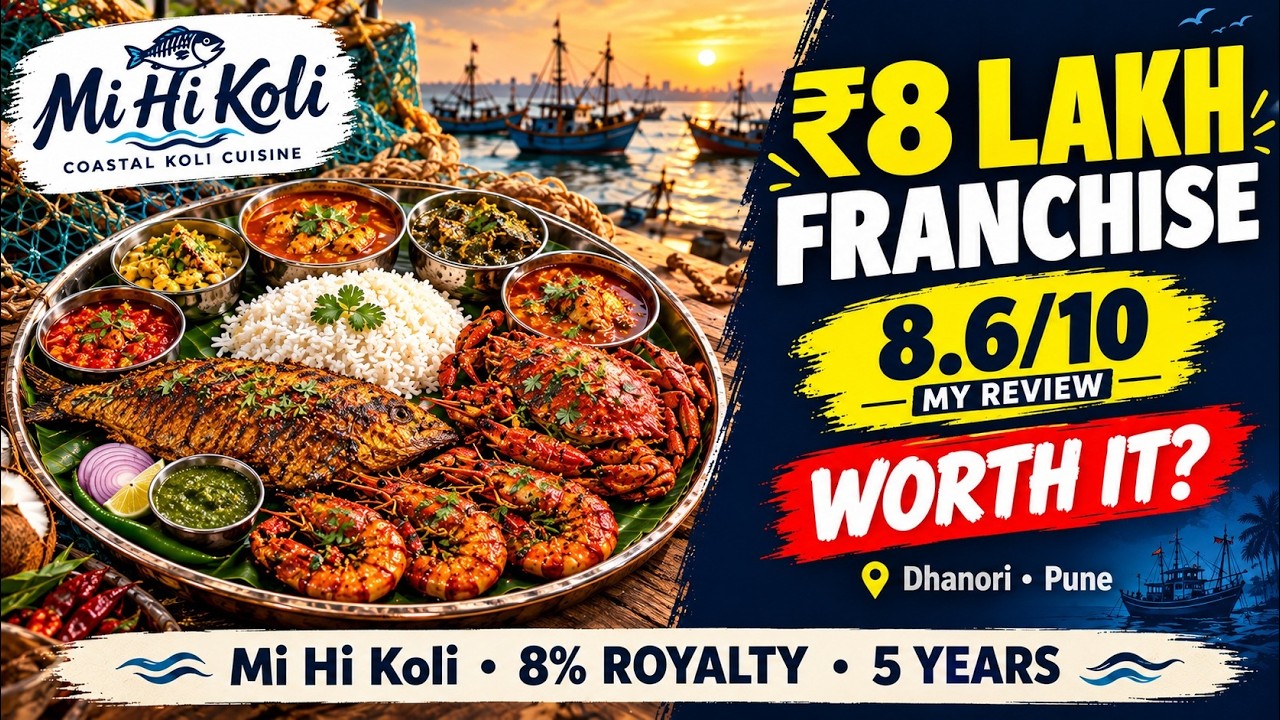
Rs.8 Lakh to Own a Coastal Restaurant? Mi Hi Koli Franchise Deep Dive | Real Investor Meeting
October 09, 2026 — ny_wk
🛒 Recommended gear on AmazonDisclosure: some links above are affiliate links — if you buy through them I may earn a small commission at no extra cost to you. Thanks for supporting the channel!
🛒 Today's Picks on Amazon
As an Amazon Associate I earn from qualifying purchases.
As an Amazon Associate I earn from qualifying purchases.
Rs.8 Lakh to Own a Coastal Restaurant? Mi Hi Koli Franchise Deep Dive | Real Investor Meeting
Mi Hi Koli is positioning itself as India's first organized coastal Koli cuisine franchise — and after attending their live investor presentation for a Dhanori, Pune location, I came away with a clear-eyed, numbers-backed verdict: 7.5 out of 10, with one massive caveat that every prospective franchisee must internalize before signing anything. If you've ever dreamed of owning a restaurant rooted in authentic Mumbai fisher-folk food, this deep dive covers the brand story, the real setup costs, the royalty structure, the menu architecture, the market opportunity, and the hard questions you need to ask before writing a single cheque.
I'll be honest — I walked into that presentation hall the same way I walk onto a volleyball court before a tough match: equal parts excitement and controlled skepticism. You want to believe in what's in front of you, but you also know that enthusiasm without data gets you killed in the third set. So I took notes obsessively, cross-referenced the spreadsheet they shared live on screen, and I'm going to give you everything I learned, unfiltered.
The Origin Story: Why Koli Cuisine Deserves Its Own National Brand
Before Mumbai became the city of Bollywood, billion-dollar startups, and soul-crushing commutes, it was a quiet archipelago of seven islands — and the Koli community were its original inhabitants. These were coastal fisherfolk who built their lives around the Arabian Sea: the daily catch, the wood-fire smoke, the slow-simmered masalas, and recipes that moved from grandmother to daughter-in-law without ever being written down. This is a cuisine shaped not by culinary schools but by the sea itself.
The tragedy — or rather, the opportunity — is that despite Mumbai being one of the world's most food-obsessed cities, Koli cuisine has remained almost invisible in the organized dining sector. You find it at local festivals, at tiny community eateries tucked into fishing villages in Versova, Worli Koliwada, and Madh Island. But there is no national chain, no QSR format, no franchise system that has taken this incredibly rich culinary tradition and made it accessible to diners in Pune, Bengaluru, or Hyderabad. That gap is exactly what Mi Hi Koli is built to fill.
The founders, Bhavesh and Manisha Koli — a husband-and-wife team — come from surprisingly complementary professional backgrounds. Bhavesh spent years as an engineer before transitioning into advertising, which means he thinks in systems, brand strategy, and consumer psychology simultaneously. Manisha is an interior designer, and her influence is visible in every corner of the Mi Hi Koli dining experience: the warmth is not accidental, the textures and color palette are deliberate choices that evoke a coastal home without veering into kitschy nautical-theme territory. Together, they've built something genuinely rare in the Indian F&B space — a brand that feels culturally grounded and operationally serious at the same time.
Their guiding belief, articulated clearly during the presentation: growth should never come at the cost of authenticity. Their tagline, "Authentic at heart. Scalable by design," isn't just marketing copy — it describes their actual operational model, which I'll get into in detail below.
Brand Credibility and Track Record: Is Mi Hi Koli Proven or Just Promising?
This is where a lot of franchise opportunities fall apart, so let me put the numbers on the table first and then add context.
- 15+ years of direct, hands-on seafood restaurant experience between the founders
- Three profitable dining restaurants currently operational — not pilot projects, not break-even units, but profitable ones
- Over 1 million diners served — a figure cited by Hindustan Times coverage of the brand
- A strong family dining and repeat customer base, which in the restaurant business is worth more than any influencer campaign
- Proven systems across kitchen operations, service delivery, and raw material sourcing
The 1 million diner milestone matters more than it sounds. In the Indian casual dining space, reaching that number with a small cluster of outlets means your per-outlet throughput is genuinely high, your repeat rate is real, and your word-of-mouth is working. This isn't a concept being tested on someone else's money. Mi Hi Koli has already done the hard part — proving that people will pay for this food, come back for it, and bring their families.
The media presence is growing. Coverage in Hindustan Times gives the brand mainstream legitimacy in a market where food media validation matters enormously to middle-class diners. Social proof compounds over time, and Mi Hi Koli is building it methodically.
What gives me pause? Three outlets is a respectable but still relatively small base. The franchise rollout, if it accelerates quickly, will test whether those proven systems truly scale or whether quality was partly a function of the founders' personal oversight at each location. This is a risk worth monitoring, not a dealbreaker — but prospective franchisees should ask pointed questions about the franchisee support structure and how it will hold up as the network grows beyond, say, 20 or 30 outlets.
The Menu Architecture: 17 Thalis and a Full À La Carte Strategy
Menu design in a franchise context is a science, not an art. Every item needs to balance authenticity, preparation consistency, food cost percentage, and broad customer appeal. Mi Hi Koli's menu architecture reflects serious thought on all four fronts.
The Thali Core — Where the Brand Earns Its Identity
The brand's backbone is 17 thoughtfully constructed thalis, spanning multiple protein categories and preparation styles:
- Seafood Thalis: Tawa Fried, Masala, Curry, and Sukka variants — each representing a distinct Koli cooking tradition
- Chicken Thalis: Masala and Sukka preparations
- Mutton Thalis: Masala Dar Kali and complementary options
- Vegetarian Thalis: Special Wedge, Matar Paneer, and Kolhapuri variants — a smart inclusion that makes the brand viable for mixed family groups
The thali format is genius for a franchise operation. A well-designed thali delivers a complete, balanced meal at a predictable price point, drives high perceived value for the customer, simplifies kitchen workflow, and controls food cost with surgical precision. When a customer sits down and orders a thali, the kitchen knows exactly what goes on that plate — that predictability is the franchise owner's best friend.
Beyond the Thali — Building Day-Part Flexibility
A thali-only restaurant risks being pigeonholed as a lunch destination. Mi Hi Koli addresses this with a robust à la carte menu that includes:
- Soups and signature starters
- BBQ and grilled preparations — a strong draw for evening dining and group bookings
- Full main course range: Masala, Sukka, Curry, and Biryani variants
- Asian and fusion dishes — modern additions that widen appeal without diluting the core identity
- Desserts curated from the coastal tradition
- Crafted mocktails designed for the family dining context
This menu breadth means a Mi Hi Koli franchise can generate revenue across lunch, dinner, weekend family meals, office group outings, and online delivery orders. That multi-channel approach — dine-in, takeaway, online delivery, and secondary channel sales — is a crucial resilience factor in the post-pandemic restaurant economy where delivery platforms have fundamentally changed how people interact with restaurant brands.
The Secret Weapon: Standardized Base Gravies
Perhaps the most operationally significant detail from the entire presentation: Mi Hi Koli has developed standardized base gravies with a 12-month shelf life. This is the technology that makes the franchise model genuinely scalable. Chef dependency is the silent killer of franchise restaurant quality — when your head chef leaves, your food quality can crater overnight. By centralizing and standardizing the masala and gravy bases, Mi Hi Koli dramatically reduces that risk. A trained team with access to the right bases can produce consistent, authentic Koli food whether they're operating in Pune, Nagpur, or Ahmedabad.
The Franchise Model: Real Numbers, Real Talk
Here's where I need you to read carefully, because the headline number of Rs. 8 lakh is true — and also somewhat misleading if you take it in isolation. Let me explain exactly what that number represents and what the full financial picture actually looks like.
The Franchise Fee and Ongoing Costs
- Franchise Fee: Rs. 8,00,000 (this is the entry cost to license the brand)
- Royalty: 8% of gross revenue, ongoing
- Territory Exclusivity: 3 km radius within Mumbai; 5 km radius outside Mumbai — a genuinely protective zone for franchise partners
- Referral Incentive: 10% referral fee for bringing new franchise partners to the network
- National Marketing: Handled centrally by Mi Hi Koli — a significant value-add
- Training, Location Guidance, Interior Design Layout, Kitchen Setup: All managed by the Mi Hi Koli team
- Raw Material Supply and Software Support: Also provided by the franchisor
On paper, Rs. 8 lakh for all of the above support infrastructure is genuinely reasonable. For context, many QSR franchises in India charge Rs. 5–15 lakh in franchise fees alone for far less support. The 8% royalty is on the higher side — industry standard ranges from 4% to 10% — but it's justified if the national marketing and supply chain support are actually delivering value.
The Real Setup Cost: What the Internal Spreadsheet Showed
During the live presentation, the Mi Hi Koli team shared their internal project cost spreadsheet on screen. This is where the number shifts significantly from the Rs. 8 lakh headline. The total fixed setup investment for a standard franchise outlet is:
- Interior Build-Out: Rs. 21,00,000 (calculated at Rs. 2,000 per square foot)
- Kitchen Equipment: Rs. 13,10,000
- Software and Hardware (POS, billing, management systems): Rs. 1,50,000
- Pre-Launch Marketing and Staff Hiring: Rs. 5,50,000
- Franchise Fee: Rs. 8,00,000
- Total Fixed Setup Cost: Rs. 49,60,000 — approximately Rs. 50 lakh
Let me be direct: Rs. 8 lakh is the franchise fee. Rs. 50 lakh is what you actually need to open a Mi Hi Koli franchise. These are two very different numbers, and if you walked in expecting to start a restaurant for Rs. 8 lakh, you need to recalibrate your financial planning immediately. This isn't a criticism of Mi Hi Koli — the Rs. 50 lakh total is actually competitive for a full-service, branded coastal dining restaurant with this level of design and kitchen infrastructure. But clarity on this distinction is essential before anyone starts a conversation with their family or their bank manager.
The Dhanori, Pune Territory Assessment: 8.6/10 — GO
The most compelling part of the session I attended was a live territory feasibility discussion for a Dhanori, Pune location — conducted in real time with the Mi Hi Koli team. The outcome: 8.6 out of 10 — a GO recommendation. Dhanori has a rapidly expanding residential and IT-adjacent catchment, a growing appetite for organized dining experiences, and limited direct competition in the coastal cuisine segment. The territory score methodology wasn't fully detailed publicly, but the parameters clearly included population density, income profile, competition mapping, and access to the target customer demographic of working families and young professionals.
For anyone in Pune evaluating this franchise — particularly in Dhanori, Viman Nagar, Kharadi, or similar growth corridors — the geographic timing appears strong right now. These micromarkets are at the inflection point where organized F&B brands establish dominance. Early movers in franchise territories like these often benefit from the compounding effect of brand awareness building precisely when foot traffic is accelerating.
The Market Opportunity: Why Coastal Cuisine Could Be India's Next Big F&B Category
I'm a volleyball player, not a stock analyst — but even I can read a market opportunity this clear. The numbers from the Mi Hi Koli presentation align with broader industry data:
- India's seafood consumption is growing at a CAGR of 10.2% — one of the strongest growth rates in the entire food sector
- The seafood market is projected to reach Rs. 5,000 billion, representing approximately 2.5x growth from current levels
- Organized seafood and coastal cuisine dining remains dramatically underdeveloped relative to the size of the opportunity
- There is currently no dominant national chain in coastal or Koli cuisine — the category leadership position is wide open
- Consumer demand for authentic regional cuisines is accelerating as Indian diners become more sophisticated and less reliant on generic multi-cuisine menus
The timing dynamic here is worth emphasizing. In the Indian restaurant franchise space, the brands that become household names are almost always those that entered an underdeveloped category early, built systems before competitors arrived, and used the franchise model to establish geographic footprint rapidly. Mi Hi Koli's window to own the coastal cuisine category at a national level is real — but it's a window, not an open door in perpetuity. As the market validates this category, better-capitalized competitors will inevitably appear.
For franchisees, this cuts both ways: early adopters get better territory choices and benefit from the brand's growth curve. Late movers may find themselves in second-tier locations competing with a more crowded field.
Honest Assessment: Strengths, Risks, and the One Thing That Determines Everything
Clear Strengths
- Genuine cultural authenticity — this isn't a manufactured food concept; Koli cuisine has 400+ years of history behind it
- Founders who understand both product and brand — a rare combination in Indian F&B
- Operational scalability through standardized bases — the 12-month shelf life gravy system is a genuine